God’s Witnesses


Isaiah says, “You are My witnesses declares the LORD.” (Isaiah 43:10) The rest of Isaiah 43 shows that God’s witnesses are the Jews. For example, verse 22 says, “Yet you have not called on Me, O Jacob; but you have become weary of Me, O Israel.” The Jews are the unwilling witnesses to the truth of the Bible since their unusual history was mapped out in advance in its pages.  The Bible says the Jews will be hated everywhere. “I will make them a terror and an evil for all kingdoms of the earth, as a reproach and a proverb, a taunt and a curse in all places where I will scatter them.” (Jeremiah 24:9)
They would be scattered to every nation. The Bible says, “Moreover, the LORD will scatter you among all the peoples, from one end of the earth to the other…” (Deuteronomy 28:64; see also Ezekiel 20:23)
It would seem obvious that if the Jews were spread thin over all the earth, they would disappear marrying the Gentiles and blending in with them, but God said this would not happen. “‘For I am with you,’ declares the LORD, ‘to save you; for I will destroy completely all the nations where I have scattered you, only I will not destroy you completely.’“ (Jeremiah 30:11)
Seventy years after the Jews went into captivity in Babylon they returned to the Holy Land under Ezra and Nehemiah just as Jeremiah 29:10 predicted.
Deuteronomy says a nation symbolized by an eagle would fight against the Jews. (Deuteronomy 28:49-50) The standard of the Roman Empire was the eagle.
The Jews would be, “led captive into all nations” until the end times (Luke 21:24)

They would return to Israel gradually. (Ezekiel 37:1-10) It was 51 years from the first Zionist conference until Israel became a nation in 1948.
They were to become one nation and not two, like they had been before. (Ezekiel 37:21-22)
This was an unusual prophesy happening to the Jews alone. Truly they are God’s witnesses.

Standing on the Promises: Christian Zionism and the Balfour Declaration


Standing on the Promises: Christian Zionism and the Balfour Declaration
Christians believing that the Jewish people have a right to live in their ancient homeland is not a new phenomenon. It has been an integral part of teaching in the Church in Britain for centuries.

By the time Lord Arthur Balfour, Britain’s Foreign Secretary in 1917, penned one of the most important documents in history, pulpits up and down the British Isles were already carrying a vision that one day the Jewish people will return home. Many Christian revivalists and Bible teachers in Britain, including Anglicans, such as Bishop J C Ryle, Charles Simeon and John Newton (Amazing Grace); Baptists such as Charles Spurgeon, John Gill and John Rippon; Scottish Presbyterian, Samuel Rutherford and Congregationalist, John Owen, among others, supported this vision. Co-founder of the Methodist Church, John Wesley, was one of many hymnists that  formed lyrics that were inspired by not just a dream, but a promise based on the Bible:
“Send then Thy servants forth to call the Hebrews home From west and east, and south, and north. Let all the wanderers come.
Where’er in lands unknown. Thy fugitives remain. Bid every creature help them on. Thy holy mount to gain.”
Charles Spurgeon wrote in 1864:
“The meaning of our text, as opened up by the context, is most evidently, if words mean anything, first, that there shall be a political restoration of the Jews to their own land and to their own nationality.”
But it wasn’t only in the Church where this vision was being harnessed. Many Christians that become famous in their fields such as Florence Nightingale and Isaac Newton held onto this promise also. Whilst in the political sphere, William Wilberforce, Lord Palmerston and Lord Shaftesbury encouraged the British government to actively support the restoration of Israel.
As God appointed Cyrus, King of the Persian Empire, to facilitate the return of the Jewish people to Jerusalem after the first exile, Britain with its Christian heritage and political interest in her Eastern Empire, was miraculously entrusted to restore God’s covenant people to the Land promised to them.
The signing of the 1917 Balfour Declaration signaled Britain’s support for the establishment of a Jewish homeland in what was then known as the territory of Palestine. After this new era of hope, however, a change in government meant that Britain’s treatment of Arabs and Jews, political dealings with the Arab nationalist movement and deceitfulness towards the Jewish people, sadly prompted many Jews to leave their ancient homeland in the 1930s and 1940s, with many settling in Europe. This put many more Jews in harm’s way and to compound this issue any Jews attempting to escape Hitler’s regime were turned away from the British Mandate of Palestine and sent back by ship because of another failed British policy. The Holocaust that followed in mainland Europe was responsible for the death of six million Jews, and while it would not have stopped the Holocaust, there is a feeling among British Christians that had Britain kept its promise to the Jewish people, many lives could have been saved.
On 14 May, 1948, Israel declared its independence a day before the British mandate was set to expire. The creation of the State of Israel was a fulfilment of the Biblical promise that the Jewish people would one day return to their homeland. The Balfour Declaration paved the way for this to happen.
Today, ninety-nine years after the historic signing of the Balfour Declaration, the State of Israel is thriving. Israel stands as a beacon of light in a very dark region of the world. It has changed the world through innovation and technology and stands as the only true democracy in the Middle East and it is the safest place for Christians in the region.
However, Israel continues to face a very real threat from terrorism that is undermining its right to exist. Terror organisations such as Hamas and Hezbollah, as well as the leadership of Iran, want to see Israel destroyed. Closer to home, anti-Israel groups seek to delegitimise Israel through the discriminatory Boycotts, Disinvestment and Sanctions (BDS) movement.
In addition to this the Balfour Declaration, and Britain’s acknowledgement of the very existence of Israel, has come under threat. In July the Palestinian leadership asked the Arab League for support in filing a lawsuit against the British Government for publishing the Balfour Declaration in 1917. In September, Palestinian leader Mahmoud Abbas told the UN General Assembly that Britain should apologise for the Balfour Declaration and more recently Palestinian officials, journalists and activists in the UK met at the launch of a campaign that is set to include a series of events over the course of the year, pressuring the British Government to apologise for Balfour.
Britain has an opportunity this centenary year to renew its support for Israel – to make a stand for Israel and the Jewish people without apology.
At CUFI, we also believe Christians have a unique opportunity to stand with our brothers and sisters in Israel and commit to speak out whenever and wherever necessary until the Jewish people are finally living in peace and security.
Christians United for Israel

Israeli institute trains Palestinian avocado growers-Irrigation technology of Israel


And yet, far from the headlines, cooperation across these populations was thriving at the Galilee International Management Institute (GIMI) in Nahalal, a city in northern Israel.
During July alone, GIMI gave a training course to Jordanian, Palestinian and Israeli olive-oil producers, taught farmers from Palestinian Authority territories to grow avocados for export, and began planning a tele-course for Gazan computer engineers meant to lead to remote employment at Israeli companies.
“This is nothing new for us,” says GIMI President Joseph “Yossie” Shevel. “We’ve been cooperating with the Palestinians for the last 30 years.”
Established in 1987, GIMI develops and presents advanced capacity-building courses for professional personnel from all over the world – from more than 170 countries so far — taught in a wide variety of languages. But local and regional needs are never far from GIMI’s radar.
The avocado-growing course came out of GIMI’s awareness that the healthful avocado is in great demand in Europe and that Israelis could help Palestinian farmers join them in offering a quality product for this “green gold” market.
“We thought we should encourage Palestinians to grow avocados based on the excellent Israeli experience. We know there is a problem of exporting agricultural goods from the West Bank to Europe and we hope to help find a way,” Shevel tells ISRAEL21c.

The GIMI course for Palestinian avocado growers was partially funded by the Israeli Foreign Ministry.
Israel avocado exports to Europe have grown to roughly 100,000 tons in recent years, comprising about a third of the winter avocado market in EU countries.
GIMI organized a training course designed for Palestinian agricultural extension officers who will then share their newfound knowledge with farmers. Funding was provided by the Israeli Ministry of Foreign Affairs and the European Union through the agency of Economic Cooperation Foundation, a Tel Aviv-based nonprofit think tank founded in 1990 to build, maintain and support Israeli-Palestinian and Israeli-Arab cooperation.
“We have many alumni in the West Bank so once we announced the program they helped us spread the word, and 28 people registered,” says Shevel. About 40 percent of the registrants were female, and some already grow avocados for export to Arab countries.
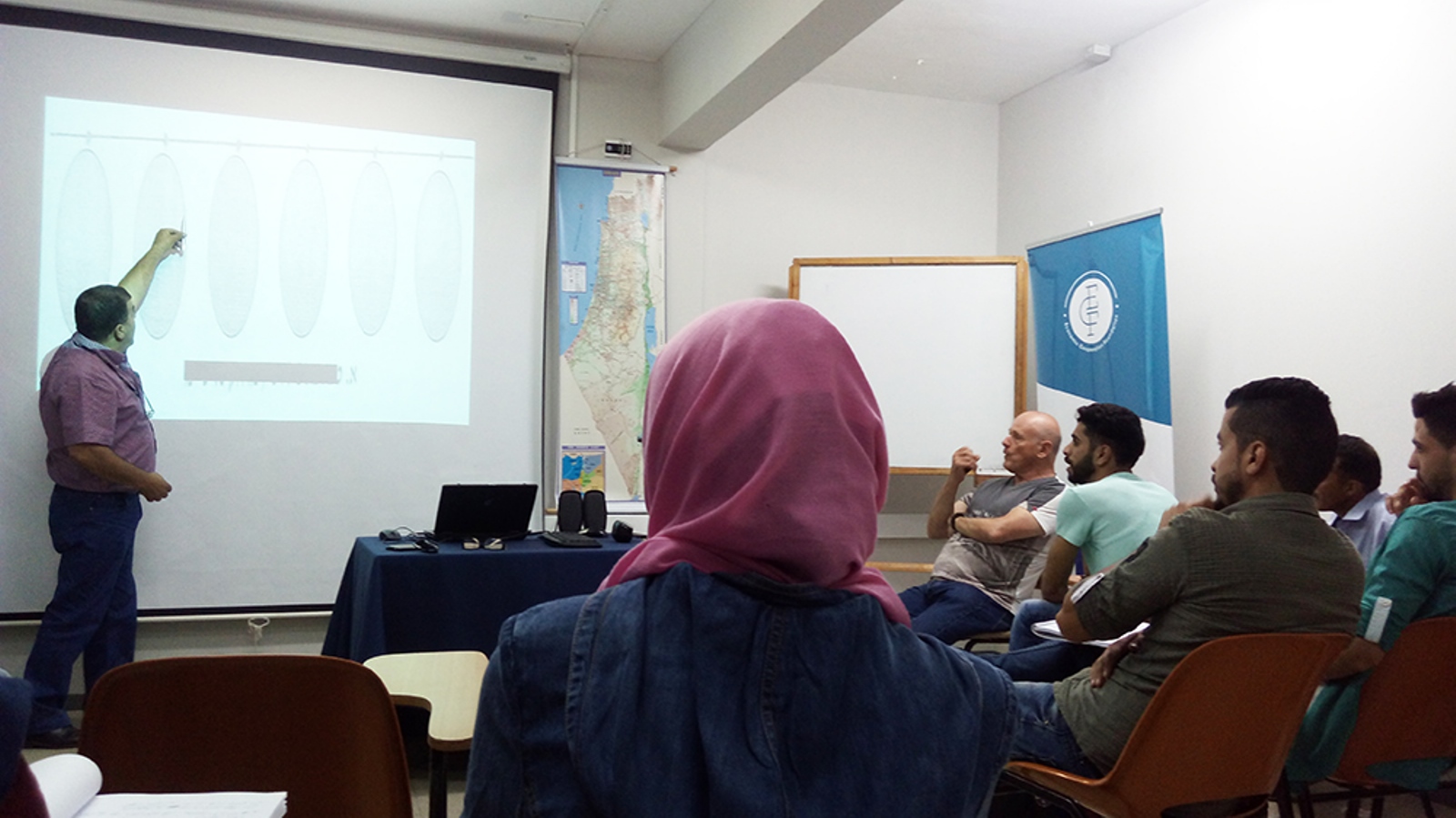
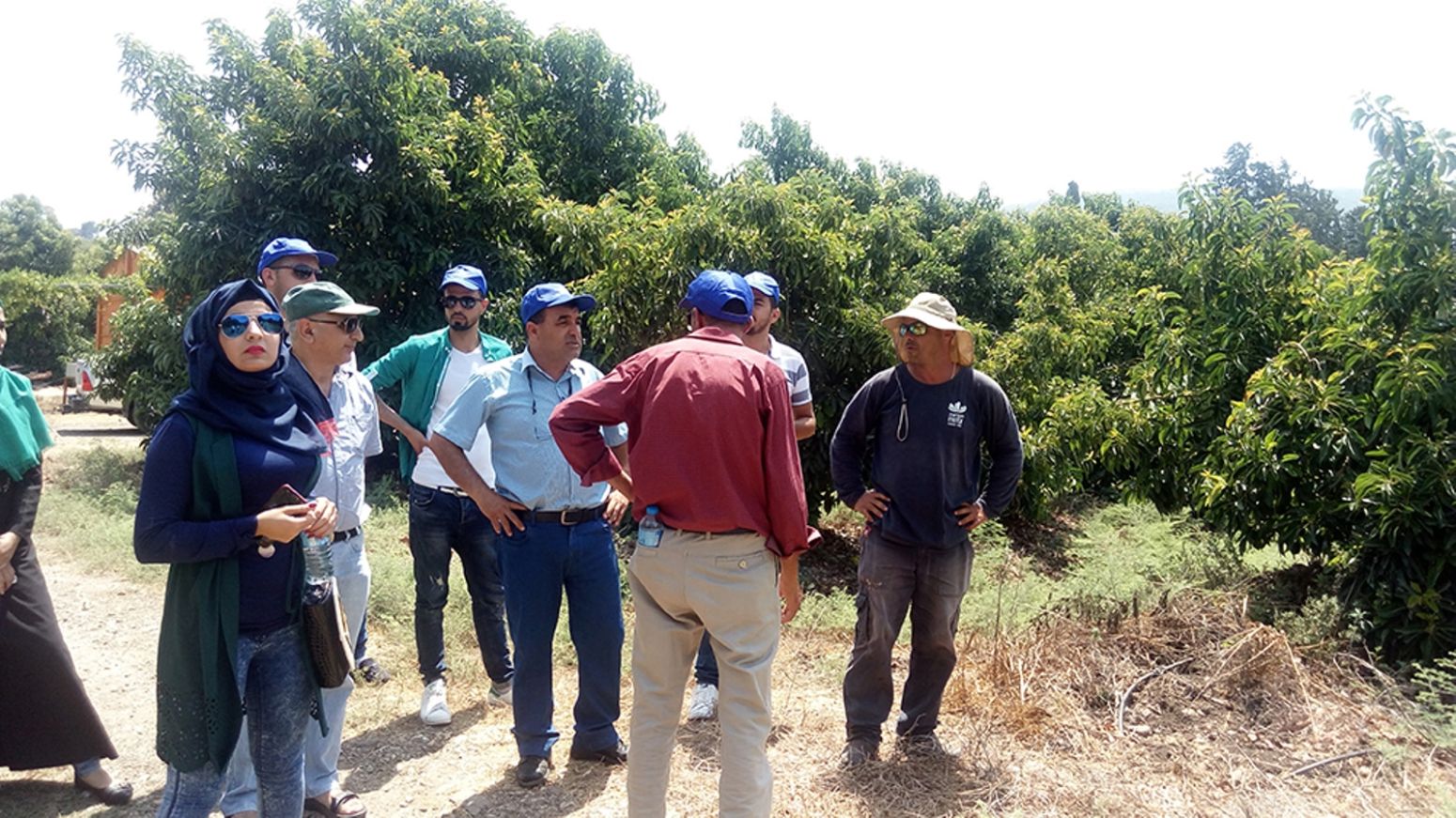
The two-week course began with online classes taught mainly by Arab-Israeli GIMI faculty members and ended with two days of in-person classes and field trips to Israeli avocado farms in the north at the end of July.

Students in the GIMI course for Palestinian avocado growers touring the fields.
Unfortunately, politics got in the way of 20 of the participants making their way to Israel for the final two days because the Palestinian Authority had halted cooperation with the Israeli government over the issue of security on the Temple Mount.
“They had permits and everything was ready,” says Shevel. “We hope to find funding for them to come and complete the course later on. Usually we manage to overcome politics.”
The eight agronomists and agricultural engineers who did manage to make it came from Hebron, Kalkilya, Tibas and Jenin, and “were received very nicely by the Israeli farmers,” Shevel says.
The course did not end with the formal sessions, he adds. “Now we’ll follow up and help them to plant avocados and work with them, especially when the crops are ready, to export to Europe.”
Breakthrough program
Shevel also is looking forward to what he calls a “breakthrough” program intended to ease the unemployment situation in the Gaza strip, which is contiguous with Israel but ruled by Hamas and therefore few people can cross the border in either direction.
Scheduled to begin in October after the Jewish high holidays, this course will train Gazan computer engineers online to qualify for jobs in Israel via remote connection.
“With globalization you can hire an engineer anywhere, so why not in Gaza, to improve their lives?” Shevel says. “At the end of the program we’ll look for Israeli high-tech companies to employ them. Already one large company made a commitment to do so, and we have two sources ready to fund the program.”
How is GIMI publicizing the course in Gaza? “We have a graduate in Gaza who studied here about 10 years ago and is in close contact with us and wants to coordinate this program for us,” says Shevel.
Perhaps surprisingly, he reveals that his efforts to reach out also have been helped by a close personal friend who is the former president of Al Aqsa University in Gaza.

“Shavuot” – What Christians should know about the Jewish festival


“Shavuot” – What Christians should know about the Jewish festival

This year the Jewish people will be celebrating Shavuot starting on 30 May 2017. Shavuot means “weeks” as it occurs seven weeks after the Feast of Passover so is often referred to as “The Feast of Weeks”.
Shavuot has a double significance. It marks the all-important wheat harvest in the Land of Israel and it commemorates the anniversary of the day God gave the Torah to the entire nation of Israel assembled under the leadership of Moses at Mount Sinai.
The Torah mandates the counting of the seven-week period beginning on the second day of Passover through to the start of Shavuot. This counting of days and weeks is understood to express anticipation and desire for the giving of the Torah. On Passover, the people of Israel were freed from their enslavement in Egypt; on Shavuot they were given the Torah and became a nation committed to serving God.
Key Facts
The Hebrew word is Shavuot (pronounced shah-voo-oat).
Shavuot means “weeks” as it occurs seven weeks after Passover.
The Greek word for this holiday is Pentecost, which means “50th”. This is because Shavuot happens 50 days (one day plus seven weeks) after the sabbath after Pentecost. (Leviticus 23:15)
Shavuot is one of the three Biblical pilgrimage festivals (alongside Passover and Succot).
In the Bible the Book of Acts chapter 2 tells of the coming of the Holy Spirit on the day of Pentecost to that small remnant of [Jewish] disciples gathered together in the upper room in Jerusalem nearly 2000 years ago. The Shavuot holiday is one of the three Biblical pilgrimage festivals that required the Jews to go up to Jerusalem for the feast.
Now at that time (see Acts 2:5) there were many devout Jews gathered from every nation who had come up to the Temple in Jerusalem to celebrate Shavuot. In Jewish tradition the Torah was revealed by God-given revelation on Mount Sinai. Indeed, Shavuot on Mount Sinai was considered the day Judaism was born. Another tradition was that King David was born on Shavuot and died 70 years later also on Shavuot so the Jews read the book of Ruth during the feast as it speaks of both the harvest and Ruth being an ancestor of David.
In the Bible (Acts 2) when Peter stood up on the Day of Pentecost and preached his message he focused on the prophecy of Joel, which explained the pouring out of the Spirit, and on King David’s prophetic Psalms, which talked of the resurrection of the Christ (Jesus) to the right hand of God. This same Peter (in Matthew 16:16) had declared to Jesus, “You are the Christ, the Son of the living God.”  And Jesus had confirmed that flesh and blood had not revealed that to him but upon this God-given revelation “I will build my Church”.
After Peter preached to the crowd on the Day of Pentecost the revelation came to many of these devout Jews and 3000 were added to their number. Many see Pentecost as the day the early Church was born. It was amazing how these devout Jews had gathered to celebrate the law being given to Moses on tablets of stone but when the Holy Spirit was poured out the law was written on their hearts (Hebrews 8:10).
This year, due to the difference between the Jewish calendar and the Gregorian calendar, the Jewish people will be celebrating Shavuot several weeks after the church celebration of Pentecost. Even the different calendars separate us from our Judeo-Christian roots. Many Christians are not even aware that the Day of Pentecost (in Acts 2 of the New Testament) occurred on the Feast of Shavuot established in the Book of Exodus (Old Testament). Sadly, far too many Christians believe the Church has replaced the Jewish people in the plans and purposes of God. That the Law has been replaced by the freedom of the Spirit and that the Old Testament has been replaced by the New. However, Jesus made it clear in Matthew 5:17-18 “Do not think that I came to destroy the Law or the Prophets. I did not come to destroy but to fulfil. For assuredly, I say to you, till heaven and earth pass away, one jot or one title will by no means pass from the law till all is fulfilled”.
We too must seek a deeper revelation of the roots of our faith and in so doing enrich our Christian lives.

One-of-a-kind hospital opens in Jerusalem where new inventions are made for each special-needs patient


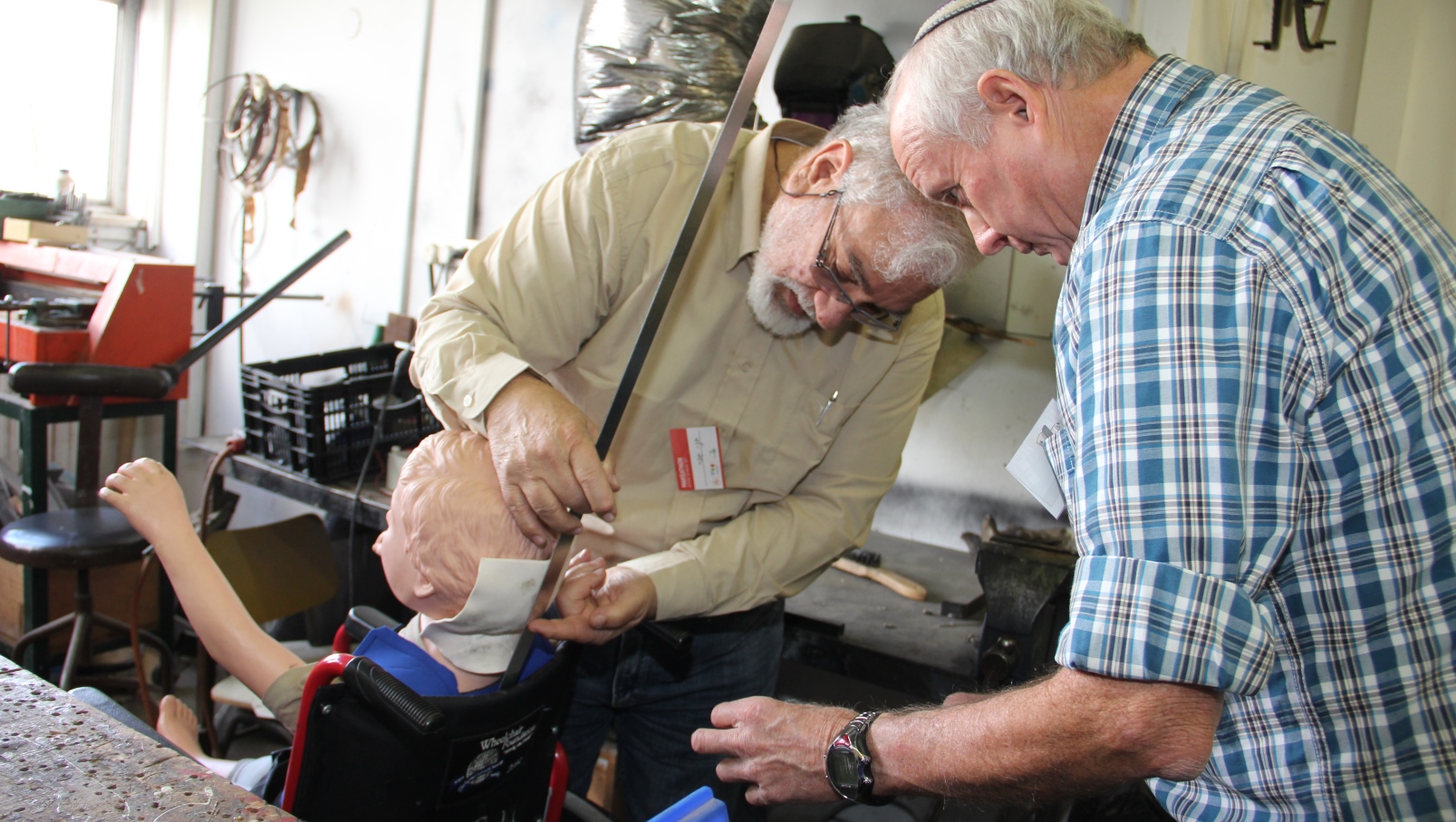
Yosef cannot hold a fork or spoon. The little boy was dependent on others to feed him until an assistive device was fashioned for him at ALYN Hospital, a nonprofit pediatric and adolescent rehabilitation facility in Jerusalem.
While inventive solutions for ALYN patients like Yosef have been created in the onsite biomechanical lab for the past 25 years, now the one-of-a-kind hospital is incorporating the lab into a unique state-of-the-art innovation center.
The center encompasses two tracks: PELE (a Hebrew acronym for Solutions for Children of ALYN), which designs case-specific solutions for special-needs children; and ALYNnovation, where entrepreneurs will develop and work with corporate partners to commercialize mass-market assistive products to enhance independence and quality of life for children with special needs everywhere.
Set to open officially in September in a former storage area of the hospital, the 500-square-meter center is built for inspiration, featuring a glass wall facing the Jerusalem Forest.
On the practical side, the center provides a single address for product design and prototyping with input from ALYN clinicians, as well as in-house product testing with the target audience.
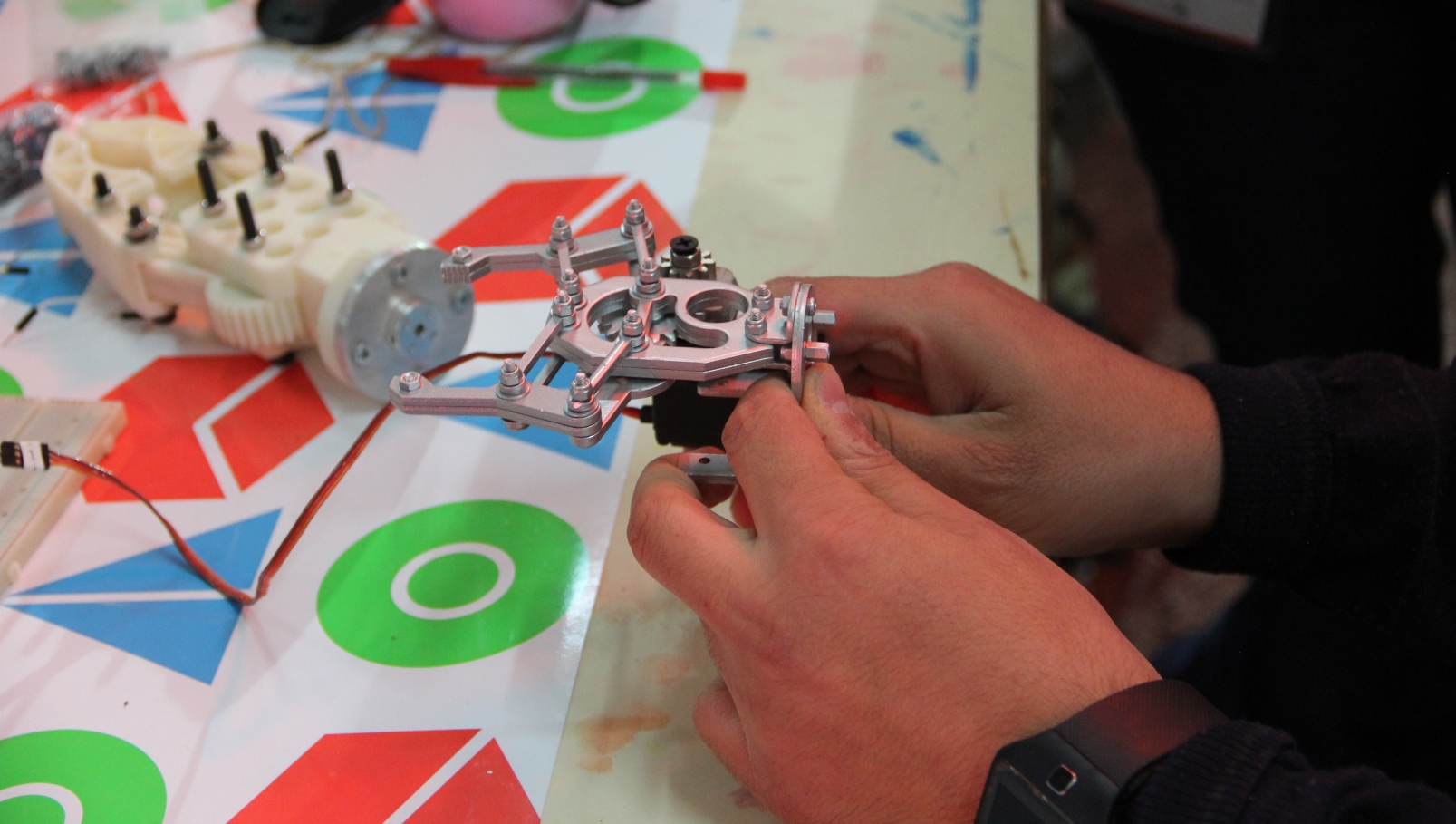
“The fact that it’s under one roof provides added value to the entrepreneurs,” says Danna Hochstein Mann, director of ALYNnovation. “They can make a prototype using our 3D printers, interact with the children in real time to test the prototype, and go back to the lab and tweak it. It’s much cheaper to do this process in the prototype stage.”
ALYN
Mann joined ALYN at the beginning of 2017 after a 12-year career in venture capital in the capital city.
“I think Jerusalem is the right place for a center of this kind, with its combination of a fast-growing entrepreneurial ecosystem, its focus on health and medical innovation and its social awareness,” Mann tells ISRAEL21c.
She points out that on Good Deeds Day in March, ALYN hosted one of two Jerusalem makeathon events focused on assistive technology. The hospital also held a makeathon last year.
ALYN Mann also chaired the board of PresenTense, which operates the A3i assistive-technologies accelerator in partnership with Beit Issie Shapiro of Ra’anana, the Ruderman Family Foundation and the Jewish Federation of Greater Los Angeles.
ALYNnovation is meant to pool Israeli expertise toward identifying and creating assistive inventions relevant to children, and get them commercialized through industrial partners.
“Everyone fits a different part of the model,” Mann says.
For example, TOM (Tikkun Olam Makers) events facilitate technological solutions for everyday challenges of individuals with disabilities.
“Maybe in situations where a TOM solution can work for a bigger audience we could take it on,” says Mann. “That’s where the institutionalization comes into play.”
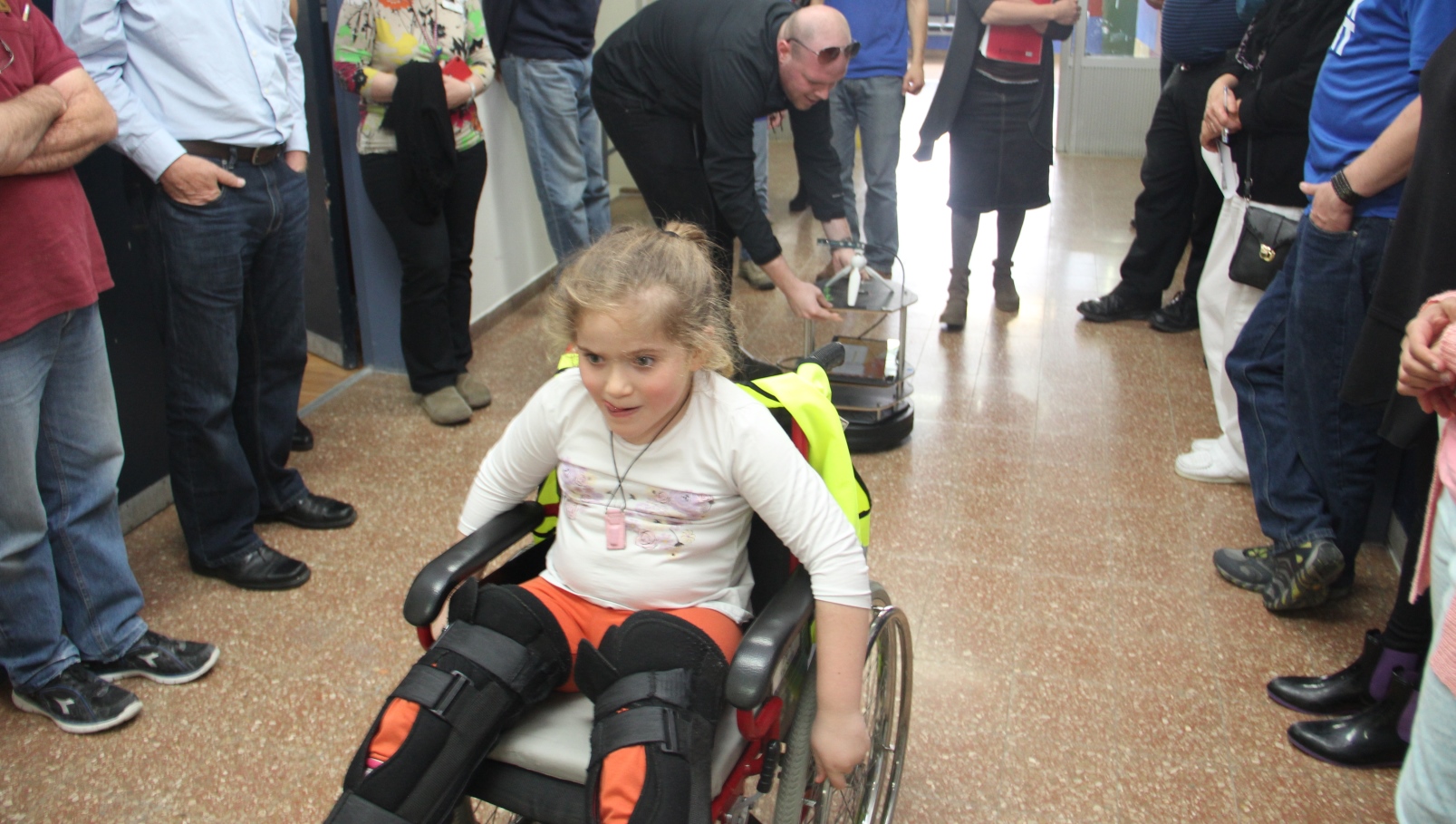
This robotic helper carries items as it follows a child in a wheelchair. Photo courtesy of ALYN
ALYN’s relationships with Israeli corporations and institutions such as Intel, the Israel Aerospace Industries, Cisco, Young Entrepreneurs Israel, Jerusalem College of Technology, Hadassah Academic College, and Bezalel Academy of Arts and Design put a lot of brainpower into crafting assistive devices for young patients.

The National Insurance Institute and the Cross-Lab Network (XLN) 3D printing project of the Tel Aviv-based Reut Institute are also supporting the endeavors of the new innovation center.

A boy who lost his limbs to predatory bacteria playing with another child at ALYN with the help of assistive gear. Photo courtesy of ALYN
“We already have a biomechanical lab here, but we decided to make an opportunity for children not only in Jerusalem but perhaps all over the world to benefit from our tailor-made solutions,” says PELE Director Hilla Boral, an occupational therapist and inventor of items such as the WeBe Baby Nest for newborns.
In coordination with ALYN’s biomechanical lab director Ohad Gaal-Dor and “an army of volunteers,” PELE was formed two years ago to more efficiently meet patient needs that can’t be solved with an off-the-shelf product – either because one doesn’t exist or because the product is too expensive.
Boral cites the example of a device that fulfilled the wish of a 13-year-old ALYN patient to wrap tefillin on his arm and head for morning prayers, in accordance with Jewish tradition, though his hands were too weak from cancer treatments to do this unaided.
Now, PELE will have a dedicated physical space and benefit from cross-pollination of ideas from ALYNnovation.
The innovation center has received about $1.7 million from the National Insurance Institute, the Jerusalem Development Authority and private contributors. An additional $2 million is being raised to assure enough funding for the first five years.