Showing posts with label Birth of Israel. Show all posts
Showing posts with label Birth of Israel. Show all posts
Israel—God Chosen People

The study of biblical prophecy has been my daily bread. My father was an evangelist who specialized in the area of Israel and Bible prophecy. Every night of the week, my sister and I were in a church somewhere hearing our father expound on world events in the light of Bible prophecy. He would often sit us down and read from the newspaper and then say, “Girls, this is a fulfillment of Bible prophecy…let’s read the Bible and you will see.” We watched the entire 1967 Six Day War on television with the knowledge that we were witnessing something significant. Only afterwards did we realize that, at that time, we were watching the fulfillment of Luke 21:24b, which says, “And Jerusalem will be trampled under foot by the Gentiles until the times of the Gentiles are fulfilled” (NASB). June of 1967 was the first time since the dispersion in AD 70 that Jerusalem was under Jewish sovereignty.
We often heard my father talk about future events the Bible foretold. Little did we know that we would live to see many of them literally fulfilled in our lifetime. At Bridges for Peace, we have a little saying: “Why just read about Bible prophecy when you can be a part of it?” I consider it an awesome privilege to be alive today and even more so to be called to be an active participant
in the fulfillment of God’s prophetic Word. I am sure the prophets who recorded the Word of God would have loved to be in our shoes, but God in His infinite wisdom chose us to be the ones to partner with Him in these last days.
in the fulfillment of God’s prophetic Word. I am sure the prophets who recorded the Word of God would have loved to be in our shoes, but God in His infinite wisdom chose us to be the ones to partner with Him in these last days.
Frequently I meet with Christian groups visiting Israel. A number of times, a pilgrim has said to me, “Wouldn’t it have been wonderful to be here when Jesus and His disciples were here, in the days of the Bible?” I chuckle and think to myself, “Oh, but these are Bible days—these are the days when God is fulfilling His promises, written in the Bible for the nation of Israel, while the world watches.”
Israel is God’s object lesson to the world. It is on this small piece of ocean-front real estate that God is showing the world that He can be trusted to keep His Word. Think of the statistical improbabilities of all the following coming together to fulfill ancient prophecies.
The Ingathering after
a 2,000-Year Dispersion
There has never, in the known history of the world, been another people group who were dispersed to multiple locations for over 2,000 years and came back to their ancient homeland. Yet, in the late 1880s, we saw the stirrings of the Spirit of God, as the Jewish people began to arrive in what was then known as Palestine. It was as if God had placed a homing instinct in them set to go off at a certain time in history, and they were compelled to come home. God dispersed the people because of their sin, and now He is bringing them back, not because they have proved themselves holy, but because He is proving His faithful character to the nations of the world. (See Ezekiel 36:19–24).
_NBN_tiram__165_110_80.jpg?resize=165%2C110&ssl=1 "Photo by Adherent") Photo by Adherent My family became involved in this effort before the Iron Curtain fell. In those days, many Jewish people were refused permission to immigrate to Israel, and some were imprisoned. They were called refusniks or prisoners of conscience. One Christmas, my father came home a few days before the holiday and told my sister Sandy and I that this Christmas was going to be different. This year we were going to think about others instead of just thinking about our presents. He presented us with gaudy, cheap, star-of-David necklaces each with the name of a refusnik on it. It was a takeoff on the Vietnam POW (prisoner of war) bracelets that everyone was wearing in the United States in the early 70s. We prayed for our person regularly. My sister really took the project to heart and prayed diligently for the person on her necklace as well as the others. One of the names was Silva Zalmonson.
Photo by Adherent My family became involved in this effort before the Iron Curtain fell. In those days, many Jewish people were refused permission to immigrate to Israel, and some were imprisoned. They were called refusniks or prisoners of conscience. One Christmas, my father came home a few days before the holiday and told my sister Sandy and I that this Christmas was going to be different. This year we were going to think about others instead of just thinking about our presents. He presented us with gaudy, cheap, star-of-David necklaces each with the name of a refusnik on it. It was a takeoff on the Vietnam POW (prisoner of war) bracelets that everyone was wearing in the United States in the early 70s. We prayed for our person regularly. My sister really took the project to heart and prayed diligently for the person on her necklace as well as the others. One of the names was Silva Zalmonson.
Some time later, while reading The Jerusalem Post International Edition, we saw a small story about her, saying that by a miracle, she had been released from prison and was now living in Israel. We were over the moon with excitement as we realized that our prayers had been answered. Later on a trip to Israel, my sister was able to meet with Silva and tell how she had prayed every day for her release. Silva cried and said that she had always wondered why she, one of the infamous Leningrad 11, was released and none of the others were. Now she knew why—it was the power of prayer. Since 1990, over 1,112,000 Jewish people have come home to Israel from the nations of their dispersion, and they are still coming. As of 2010, of the 5,700,000 Jews in Israel, around 1,720,000 came as immigrants, most of the remainder being children or grandchildren of immigrants.
National Identity
 Rishon LeZion
Amos Meron/wikipedia.org The Jewish people were dispersed to over 100 nations throughout the world, and yet they maintained their Jewish identity and their heart connection to the Land of Israel. If you visit the Diaspora Museum in Tel Aviv, Israel, you will see exhibits that show common elements of Jewish practice, which could be found in every Jewish home, regardless of whether that home was in Europe, Asia, or Africa. I grew up in the United States. In comparison to the ancient world, the US is a youngster. My family’s ancestors (on my father’s side) have been in the US since before the Civil War, some since the days of independence—more than 200 years. But, when you ask my father what
nationality he is descended from, he will tell you that he is a mixed-breed. It is hard to find a European country from which he doesn’t have an ancestor. The United Sates has been called a melting pot, and my father is proof.
Compare our experience in the United States with the Jewish experience. For over 2,000 years, the Jewish people have resisted the melting pot temptation and remained a unique people. Over the long centuries of dispersion, they were not forgotten by God; He preserved them as a people.
A Nation Born in a Day
 In spite of overwhelming odds against her, Israel became a nation on May 14, 1948. The next day, five hostile Arab armies attacked the fledgling state. With little ammunition, soldiers (many of whom were refugees just off the ships from Nazi-torn Europe), and an air force that consisted of a few small planes, Israel defeated her enemies. The Arab world was stunned, and the nations looked on in amazement. God was not surprised! This moment in history was foretold over 3,000 years earlier: “Can a land be born in one day? Can a nation be brought forth all at once? As soon as Zion travailed, she also brought forth her sons” (Isa. 66:8, NASB). On May 13, the State of Israel did not exist, and then the next day, she was a reality!
Dead Language Revived
The Jewish people came from over 100 nations and spoke a wide variety of languages. How do you create a nation when you can’t even communicate in a common language? Hebrew was nearly a dead language, only used for prayers and Bible reading. A visionary by the name of Eliezer Ben Yehuda, upon arriving on the shores of Palestine, refused to speak anything but Hebrew. His child was the first child in nearly 2,000 years whose native tongue was Hebrew. Eliezer was instrumental in Hebrew becoming a living language once again. Today, Hebrew is the native tongue to millions. A language that was only used for religious purposes is now used for the sacred and the mundane.
A Depleted, Tired Land Restored
Mark Twain visited the Land in the 1800s and described it in his book Innocents Abroad. He called it a “blistering, naked, treeless land.” He called the villages “ugly, cramped, squalid, uncomfortable and filthy.” Other descriptive phrases say “solitude to make one dreary; unpeopled deserts, rusty mounds of barrenness that never, never, never do shake the glare from their harsh outlines; this stupid village of Tiberias, slumbering under its six funereal plumes of palms; yonder desolate declivity where the swine of the miracle ran down into the sea and doubtless thought it was better to swallow a devil or two and get drowned into the bargain than have to live longer in such a place.”
Nachmanides, a Talmudic scholar, visited in 1267 and described Jerusalem as “deserted and laid waste and Judea was more destitute than Galilee.” George Sandys reported in 1610 that the “land is bare of trees. The country is a vast empty ruin.” Colonel C. R. Condor wrote in 1877 that “Palestine is empty. The population is not large enough to till the land.” In 1831, Michael Russell wrote in his book Palestine or the Holy Land that “Jericho, once famous for its palm and balsam trees, is treeless and almost deserted.”
Today, as you visit Israel, you will see a far different reality. The Land is being restored to its former beauty as prophesied:
• “On that day I raised My hand in an oath to them, to bring them out of the land of Egypt into a land that I had searched out for them, flowing with milk and honey, the glory of all lands” (Ezek. 20:6).
• “I will open rivers in desolate heights, and fountains in the midst of the valleys; I will make the wilderness a pool of water, and the dry land springs of water. I will plant in the wilderness the cedar and the acacia tree; the myrtle and the oil tree; I will set in the desert the cypress tree and the pine and the box tree together, that they may see and know, and consider and understand together, that the hand of the LORD has done this, and the Holy One of Israel has created it” (Isa. 41:18–20).
• “The desert and the wasteland will be glad for them, and the desert shall rejoice and blossom as the rose; it shall blossom abundantly and rejoice, even with joy and singing. The glory of Lebanon shall be given to it, the excellence of Carmel and Sharon. They shall see the glory of the LORD, the excellency of our God” (Isa. 35:1–2).
 gkuma/shutterstock.com There is a special connection between the fruitfulness of the Land of Israel and the Jewish people. The Land flourishes when the Jewish people live here and falls into desolation when they are gone. I believe that this land/people connection is a direct result of the special covenant that God made with the Jewish people.
God claims in Leviticus 25:23 that He is the owner of this Land. “The land shall not be sold permanently, for the land is Mine…” God chose to give the Land to the children of Abraham, Isaac, and Jacob as an everlasting inheritance. “‘I will plant Israel in their own land, never again to be uprooted from the land I have given them,’ says the LORD your God” (Amos 9:15, NIV).
 www.wikipedia.org Why did God make this unusual covenant between a people and a land? There is a good answer! God placed the Jewish people in Israel to be a witness of His character. In the ancient world, all the peoples had gods who they looked to for fertility, rain, crops, etc. Most of the peoples were polytheistic, praying to multiple gods, but God had revealed Himself as the One True God to Abraham and his descendants. Their presence in the Land of Israel as His worshippers was a constant witness to the peoples round about. Israel was the highway of the ancient world, forming a natural land bridge between three major continents. If you wanted to travel from Africa to Europe or Asia, you had to pass through Israel. To the east, the treacherous deserts made travel extremely difficult, and to the west was the Mediterranean Sea. Traders, armies and travelers all passed through Israel, and on their way, they heard about the miracle-working God of the Israelites. In this way, God caused His fame to spread throughout the ancient world. Only when the Land and covenant people are together in combination, do both flourish in accordance with God’s divine plan. The prophet Ezekiel confirms it is the return of the Jewish people to the Land of Israel that triggers the restoration of the Land. “But you, O mountains of Israel, you will put forth your branches and bear your fruit for My people Israel; for they will soon come” (36:8, NASB).
The Bible contains many beautiful prophecies concerning the Land that have seen their fulfillment in modern times:
The desert shall blossom as the rose (Isa. 35:1–2). Today, millions of flowers grown in the deserts of Israel are exported to Europe. Holland even imports tulips from Israel!
 Israel will fill the earth with fruit (Isa. 27:6). Millions of fruit trees have been planted in Israel, reaping a huge export harvest every year. Around the world, people eat the juicy “Jaffa” orange.
Israel will become like the garden of Eden (Isa. 51:3).
Christians all over the world have become involved in the restoration of the Land of Israel through planting trees, praying for abundant early and latter rains and eating the produce of Israel.
Miracles in Battle
__158_165_80.jpg?resize=158%2C165&ssl=1 "Israeli soldiers leave LebanonPhoto by Ashernet") Israeli soldiers leave Lebanon
Israeli soldiers leave LebanonPhoto by Ashernet There are many stories of miracles on the battlefield. Let me tell you one of them that we heard firsthand from a young Israeli man. My husband and I volunteered on a kibbutz (a collective community) for nearly a year when we first came to Israel. During that year, we met a young Israeli man named Ari. He was thoroughly secular in his lifestyle and was a difficult person to be around. One day, Tom asked him why he didn’t believe in God. Ari became indignant and protested, saying, “Of course I believe in God.” So, Tom asked him to explain.
Ari told a fascinating story of God’s miraculous protection of a group of soldiers. Ari was a commander of a group of 10 soldiers. They were in a canyon doing reconnaissance in southern Lebanon, when suddenly an enemy soldier popped from behind a rock and began to fire with a Kalashnikov automatic weapon. He was at point blank range, and there was no place to run. He emptied a clip into the group and started a second clip before one of the soldiers managed to shoot him. Shaken, the soldiers looked around, expecting to see their comrades lying dead on the ground. Instead, to their utter amazement, they were all standing, and not one had been hit by a single bullet. That is an absolute miracle! “So, how do you explain that, Ari?” Tom asked. “It was like angels were standing in front of each of us, batting the bullets out of the way. We all felt them whizzing by.” Ari went on to say, “How can I not believe in God after an experience like that?”
Future Miracles
 I hope I have whetted your appetite a little. If God fulfilled all of these promises in the life of modern Israel, surely we can trust Him to fulfill the rest! There is more to come! It is God’s plan that the people of Israel know Him, love Him, and put their trust in Him. We have the awesome privilege to be part of what God is doing now and in the days to come. Consider a few marvelous prophecies to come:
“Then the eyes of the blind shall be opened, and the ears of the deaf shall be unstopped. Then the lame shall leap like a deer, and the tongue of the dumb sing. For waters shall burst forth in the wilderness, and streams in the desert. The parched ground shall become a pool, and the thirsty land springs of water; in the habitation of jackals, where each lay, there shall be grass with reeds and rushes. A highway shall be there, and a road, and it shall be called the highway of holiness. The unclean shall not pass over it, but it shall be for others. Whoever walks the road, although a fool, shall not go astray. No lion shall be there, nor shall any ravenous beast go up on it. It shall not be found there. But the redeemed shall walk there. And the ransomed of the LORD shall return and come to Zion with singing, with everlasting joy upon their heads. They shall obtain joy and gladness, and sorrow and sighing shall flee away” (Isa. 35:5–10).
“I will give you a new heart and put a new spirit within you: I will take the heart of stone out of your flesh and give you a heart of flesh. I will put My Spirit within you and cause you to walk in My statutes, and you will keep My judgments and do them” (Ezek. 36:26–28).
“‘But this is the covenant that I will make with the house of Israel after those days,’ says the LORD: ‘I will put My law in their minds, and write it on their hearts; and I will be their God and they shall be My people. No more shall every man teach his neighbor and every man his brother, saying, “Know the LORD.” For they all shall know Me, from the least of them to the greatest of them,’ says the LORD. ‘For I will forgive their iniquity, and their sin I will remember no more’” (Jer. 31:33–34).
“And so all Israel will be saved, as it is written; ‘The Deliverer will come out of Zion, and He will turn away ungodliness from Jacob [Paul quoting Isa. 59:20]; for this is My Covenant with them, when I take away their sins [Paul quoting Isa. 27:9]’”(Rom. 11:26–27).
Israel—God’s Miracle in the Making
 Bridges for Peace blessing Israel for more than 50 years God’s Word resounds down through the ages with the promises for the restoration of Israel. God is bringing the people back from the nations of their dispersion, establishing the State of Israel, and restoring the Land. I am confident He will finish His work in such a way that the nations of the world will know that He is God.
Isaiah 62:10 is part of my own call from God. “Go through, go through the gates! Prepare the way for the people; Build up, build up the highway! Take out the stones. Lift up a banner for the peoples!” Truly God is using Christians today to assist in His great plans for Israel. No one knows at what speed the Lord will move to finish His plans. But this I know, there will be Christians ready and willing to assist in any way He asks. James said that faith without works is dead. My father paraphrased that statement and said, “Belief without action is deception.” We see God at work, and we believe He will finish what He started, so let’s partner with God in prayer and action to see His name glorified throughout the world.
ISRAEL’S RIGHT TO EXIST SPELLED OUT LOUD AND CLEAR
A brilliant and succinct dossier articulating the legal and historical background that is essential to understanding Jewish rights in the land. It is extremely important to save and share this material, as it provides data critical for properly defending Israel.

With the destruction of the Second Temple in 70 CE, the Second Jewish Commonwealth came to an end. From then until modern times, what had been Judah, and was renamed Palestina by the Romans, was only an appendage to one empire or another, never an independent country.


Credit: Hebroots

Credit: Wikipedia
Credit: buildersofzion

With the destruction of the Second Temple in 70 CE, the Second Jewish Commonwealth came to an end. From then until modern times, what had been Judah, and was renamed Palestina by the Romans, was only an appendage to one empire or another, never an independent country.
San Remo:
Jewish legal rights in the land in modern times began with the San Remo Conference and resultant San Remo resolution, which has been called the Jewish Magna Carta.
For centuries, Palestine had been part of the (Turkish, Muslim) Ottoman Empire. With the end of WWI, the land of that Empire was taken by the Allies. Great Britain, France, Italy and Japan, with the US as observer, met in San Remo, Italy, to decide how it would be divided: Palestine was put under British Mandatory rule.
Below is an excellent 15 minute film about the discovery of the formerly classified minutes from the San Remo peace conference of April, 1920. This long hidden document explains the legal rights of the Jews as well as the Palestinians. By returning to the negotiating table and respecting historical facts and international law the film believes there can be real peace between Israel and the Palestinians.
Balfour Declaration:

At San Remo it was decided to incorporate the Balfour Declaration into Britain’s mandate. The Declaration, in the form of a letter, was an endorsement by the British government of the establishment of a Jewish home in Palestine. Written in 1917 by the British Foreign Secretary Lord Balfour, and sent to Lord Rothschild, it stated:
“His Majesty’s Government view with favour the establishment in Palestine of a national home for the Jewish people, , and will use their best endeavors to facilitate the achievement of this object.”
By “Right”:
In June 1922, Winston Churchill, who was then British Secretary of State for the Colonies, wrote in a policy paper that:
“…in order that this community should have the best prospect of free development and provide a full opportunity for the Jewish people to display its capacities, it is essential that it should know that it is in Palestine as of right and not on sufferance.”
League of Nations Formalizes Mandate:
In July 1922, the League of Nations, predecessor to the UN, formally adopted the British Mandate for Palestine — a legally binding document that was approved by all 51 members of the League of Nations.
It agreed that:
“the Mandatory [Britain] should be responsible for putting into effect the declaration originally made on November 2nd, 1917 [Balfour Declaration], by the Government of His Britannic Majesty, and adopted by the said Powers, in favor of the establishment in Palestine of a national home for the Jewish people…”
And it gave recognition to:
“the historical connection of the Jewish people with Palestine and to the grounds for reconstituting their national home in that country.”
The term “reconstituting” gave acknowledgement to the fact that there had been a Jewish nation in Palestine at an earlier time.
“Mandate” Explained
The mandatory system of the League of Nations was based on the principle of Allied administration of Mandate territories until such time as they were able to stand alone. That is, it was understood at the beginning that the British would ultimately withdraw, leaving an established Jewish homeland.
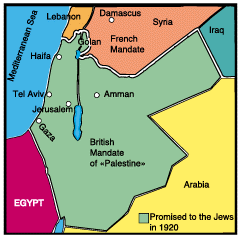
Area of Mandate Palestine
The original area of Palestine, for which the British Mandate was assigned, included Transjordan (what is today Jordan, on the eastern side of the Jordan River).
Credit: Hebroots
In September 1922, very soon after the League of Nations had adopted the Mandate resolution, Britain assigned TransJordan to Hashemite Arabs from Saudi Arabia. The Jewish part of the Mandate was thus reduced by over 70%.
Jews then had the right to settle anywhere in a 10,000 sq.mi. area between the Jordan River and the Mediterranean Sea.
Mandate Transfer to UN:
With the formal demise of the League of Nations in 1946, the United Nations was established to succeed it. The UN assumed obligations of the League: Territories under Mandate were to have a “trusteeship system” applied — this was a continuation of the Mandate system of the League.
Article 80 of the UN declared that “nothing in the [UN] Charter shall be construed…to alter in any manner the rights whatsoever of any states or peoples or the terms of existing international instruments.” This preserved the Jewish right to settle in Palestine.
Violence in Palestine:
From the time of the establishment of the Mandate for Palestine, Arab challenges to it were considerable, and were often expressed violently. This was in spite of the fact at that the same that the Mandate for Palestine was established for the Jewish homeland, Mandates for Syria, Lebanon and Iraq were established, all for Arab populations. Arabs were, and still are, offended by the presence of a Jewish state.
Perhaps most grievous of all was the Hebron massacre of 1929: for three days Arabs went on a murderous rampage in the city, killing 67 Jews and destroying property. In the aftermath, the second holiest city of the Jews was left bereft of Jews for the first time in hundreds of years. (Ultimately the British prevented Jews from living in the city because they said they couldn’t protect them.)
Partition of Palestine:
In 1947, the British, who no longer wished to contend with the situation, declared intention to pull out by mid-1948, and turned the Mandate back to the United Nations. A UN Commission considered the matter and recommended a partition of Palestine into one state for the Jews and one for the Arabs, with Jerusalem to be internationalized at first.

Credit: Wikipedia
This recommendation was placed before the General Assembly as Resolution 181, which was adopted on November 29, 1947 by a vote of 33 to 12, with 10 abstentions. The Arab nations voted as a bloc against.
It is imperative to note that General Assembly Resolutions carry no weight in international law. This resolution was only a recommendation — it was not binding and it did not supersede the Mandate for Palestine in international law.
Legally, this plan would have had binding force only as an agreement between the two parties, i.e., the Jews of Palestine and the Arabs of Palestine.
However, while the Jewish population of Palestinian accepted the proposal, the Arab population did not: they rejected the entire resolution. Thus the partition plan was aborted.
However, while the Jewish population of Palestinian accepted the proposal, the Arab population did not: they rejected the entire resolution. Thus the partition plan was aborted.
There is no way for Arabs today to re-instate this resolution or to claim that Jews have a right to only what was defined as a Jewish state by this aborted resolution.
Declaration of the Establishment of the State of Israel:
On May 14, 1948 (Hebrew date: 5th of Iyar 5708), the Jewish People’s Council gathered at the Tel Aviv Museum, and approved a proclamation, declaring the establishment of the State of Israel.
It asserted the natural right of the Jewish people to be like all other peoples, exercising self-determination in its sovereign state and proclaimed the establishment of a Jewish state named “the State of Israel.”
It is important to note that Israel’s legal legitimacy did not derive from the aborted partition plan — even though the state was founded on that portion of Palestine that Resolution 181 had allocated for a Jewish state.
It was established according to international norms: based on a declaration of independence by its people and on the establishment of an orderly government within territory under its stable control.
The portion of Palestine on which Israel was not established became unclaimed Mandate land. Nothing in international law had superseded the status of this land as Mandate land.
War of Independence
Within a day of the establishment of the State of Israel, it was attacked by the states of the Arab League, with clear, openly stated, intention of destroying the new state.
When the war ended in 1949, Israel controlled more territory than it had when independence was declared. Egypt controlled Gaza, and Jordan controlled Judea and Samaria (the West Bank). Western Jerusalem was in Israel’s hands, and eastern Jerusalem in Jordan’s hands.

Credit: buildersofzion
Armistice agreements were signed between Israel and the Arab states with which it had been at war. Armistice lines — temporary ceasefire lines — were defined by these agreements. They are often referred to as the Green Line.
These armistice demarcation lines did not define a permanent border for Israel. The agreement between Israel and Jordan includes this phrase:
“The Armistice Demarcation Lines defined…in this Agreement are agreed upon by the Parties without prejudice to future territorial settlements or boundary lines…”
This is exceedingly important because the PLO/PA claims that this line is Israel’s “real” border and the line to which it must withdraw. This is simply not the case.
This is exceedingly important because the PLO/PA claims that this line is Israel’s “real” border and the line to which it must withdraw. This is simply not the case.
Six Day War
From June 5 to June 10, 1967, Israel fought a defensive war against Arab forces from Egypt, Syria and Jordan.
When it was over, Israel had control of all of Jerusalem, which was united under Israeli sovereignty; the Golan Heights, to which Israeli civil law was applied; the Sinai, which was surrendered as part of the 1979 peace treaty with Egypt; Gaza, which was surrendered in the 2005 disengagement; and Judea and Samaria.
242
In November 1967, the Security Council adopted Resolution 242, which addressed the situation.
This resolution did not require Israel to withdraw to the Green Line. Instead it acknowledged the right of every state in the area “to live in peace within secure and recognized boundaries free from threats or acts of force.”
Implicit here was the understanding that the Green Line did not represent a secure boundary. Israel suffered from a lack of strategic depth within the Green Line — at its narrowest only nine miles wide — which invited attack and made defense in war time difficult. (This is why Israeli statesman Abba Eban referred to the Green Line as the “Auschwitz borders.”)
Thus this resolution called for Israel to withdraw from “territories occupied in the recent conflict.” “Territories,” not “the territories” or “all territories,” meaning, withdrawal from some but not all of the area of Judea and Samaria. There is a legal history of long debate over this wording, because of its significance. Not full withdrawal because that would not leave Israel with a secure boundary.
Once again, then, we see that the claim of the PLO/PA that Israel “must” withdraw to the Green Line is not supported by the facts.
Lastly, the resolution called for “a peaceful and accepted settlement in accordance with the provisions and principles in this resolution.” That is, it called for negotiations to determine the final border of Israel.
There was no requirement that Israel withdraw prior to negotiations. And those negotiations have never been held. At the time of this resolution, it was assumed that negotiations would be with Jordan. Today the situation has changed.
“Occupation”
There is nothing in Resolution 242 that forbids construction of settlements in Judea and Samaria by Israel. As this issue is a critical one now, we need to look at this a bit closer:
Israel is not an “occupier” in Judea and Samaria.
The word “occupation” is bandied about regularly. The PA/PLO have adopted the idea of Israel as “occupier” as a mantra and much of the world has accepted it. But the facts tell us something else.
- Judea and Samaria were (and still are) unclaimed Mandate land, to which Israel has the strongest claim.
- Legally, occupation only occurs when one nation moves into the land of another. But there was no nation legally sovereign in Judea and Samaria before 1967 — Jordan’s presence there was not legal
- There are strong legal precedents for the claim that a war fought defensively permits retention of the land secured in that war.Wrote Steven Schwiebel, former judge of the International Court of Justice:
- With all of the above, it should not be forgotten that areas over the Green Line, in eastern Jerusalem and Judea and Samaria, represent the very heart of Jewish heritage: From the Temple Mount; to Hevron and the Cave of Machpelah, where the matriarch and patriarchs are buried; to Shilo, where the Tabernacle was brought. How can Jews be “occupiers” in their own ancient land?
“…the Israeli conquest of Arab and Arab-held territory was defensive rather than aggressive conquest.“…it follows that modifications of the 1949 armistice lines.. are lawful…whether those modifications are, in Secretary Rogers’s words, ‘insubstantial alterations required for mutual security’ or more substantial alterations – such as recognition of Israeli sovereignty over the whole of Jerusalem.”
International Law
People have the impression that “international law” is a firmly defined body of law. In point of fact, while some international law is established in formal documents, others aspects are very fluid. Just as is the case with “occupation,” there is a tendency to politicize this term, so that Israel is forever accused of “violating international law.” Be most cautious when hearing this.
There are, as well, instances in which “international law” is interpreted to mean one thing for Israel and another for other countries.
One fascinating example has to do with the Fourth Geneva Convention, Article 49(6), which says “the Occupying Power shall not deport or transfer parts of its own civilian population into the territory it occupies.” You may have heard accusations that Israel is in defiance of this Article because of the “settlers.”
There are two obvious retorts to this: First, that Israel is not an occupier, and second, that Israel is not deporting or transferring parts of its own civilian population — the people go of their own volition.
Eugene Kontorovich, however, is currently doing research for a paper and has discovered something else: There are many instances of movement of civilian population into occupied territory. However, while international lawyers claim that Israel must actively oppose civilian migration, refuse to provide services to settlers, etc., in these other instances the reaction is much more tempered. That is, the presumed requirements of “international law” are applied selectively to Israel.
UN Report shows Israel is one of the happiest countries in the world

The World Happiness Report 2016 Update, which ranks 156 countries by their happiness levels, was released in Rome in advance of UN World Happiness Day, 20 March. The report showed that Israel was ranked the 11th happiest country in the world, beating countries like the USA, France and Britain.
The top 10 this year were:
- Denmark
- Switzerland
- Iceland
- Norway
- Finland
- Canada
- Netherlands
- New Zealand
- Australia
- Sweden
Israel was just outside the top ten, coming in at number 11 and was listed as happier than the United Kingdom which came in at number 23. The United States was at 13, France at 32, and Italy at 50.
According to the World Happiness Report, “the widespread interest in the World Happiness Reports, of which this is the fourth, reflects growing global interest in using happiness and subjective well-being as primary indicators of the quality of human development.”
“Because of this growing interest, many governments, communities and organizations are using happiness data, and the results of subjective well-being research, to enable policies that support better lives.”
They also went on to say that this year, for the first time, they gave a special role to “the measurement and consequences of inequality”, stating that “the inequality of well-being provides a broader measure of inequality” and finds that people “are happier living in societies where there is less inequality of happiness”.
This is positive news for a nation like Israel. While many people try to label Israel as “apartheid”, these lies about Israel never hold much weight and reports like the World Happiness Report (which, believe it or not, comes from the UN) is further proof that Israel, while not perfect, is far from apartheid.
It also shows that many nations that are home to growing movements against Israel may, in fact, have greater levels of inequality themselves.
Israel -Small But Outstanding Video
How can it be that such a little country can be so much? Watch this video

THE BIRTH OF A NATION

God puts His plans into effect by means of chosen instruments. Of no time in the world’s history could it be said that His witnesses were not in the earth, manifesting His standards to a generally heedless world and telling the more thoughtful among them of things that must surely come to pass. In times of crisis His prophets have been ever to the front, and at seasons of disaster His ministers have been there pouring in the oil of comfort and binding up the brokenhearted. (Isa.61. 1). Who will fill that position when the last great crisis comes upon the nations? The world generally will be in a state of turmoil and in no particular frame of mind to listen to any voice that speaks for God; in any case it will be gathering its forces for the final onslaught on the citadel of God’s holiness. Awaiting that onslaught stands the nation which of all the world has pledged itself unreservedly to the standard of Heaven and is prepared to stand or fall by that pledge. Who are these people pictured dwelling at peace in an undefended land awaiting in confidence the advance of their foe? Old Testament prophecy awards this role to the whole nation of Israel, recovered from all the lands into which, for more than two millenniums past, they have been dispersed. In that manner the prophecies enshrine a vital truth, that God is to plant a “dedicated nation” in the land which is peculiarly His own (Deut. 12. 11) and in that manner reverse the terrible end to which Israel’s national existence came when the Roman general Titus captured Jerusalem in A.D.70 and dispersed the people of Judea and Galilee to all parts of the Roman world. But this was not the only dispersal among the nations suffered by Israel and a proper understanding of the regathering can only be had if consideration is given to the history of Israel’s exile among the nations. There have been three major scatterings. The first was due to the Assyrian invasions of the eighth century B.C. when Shalmaneser and Sargon of Assyria between them overran the ten tribe kingdom and carried most of the population into Armenia and Media. A few years later Sennacherib invaded Judea and sent many of its inhabitants to join them. None of these came back. Through the centuries their descendants drifted eastward, across Iran, Afghanistan, Pakistan, and westward into Southern Russia and Europe. The second dispersal was that of the two tribes, Judah and Benjamin, at the hand of Nebuchadnezzar of Babylon in the sixth century B.C. His forces desolated the land, destroyed Jerusalem and the Temple, and took the greater part of the people captive to Babylon. A few escaped into Egypt and the poorest of the peasantry were allowed to remain to cultivate the land. Seventy years later Cyrus of Persia, conqueror of Babylon, allowed those Jews who so desired to return and rebuild the Temple, and re-establish some sort of national life. The Jewish community in Babylon must have grown quite substantially but only some forty-two thousand accepted the offer and settled in Judea. The rest of the country was populated by Samaritans, Phoeniciansand Edomites and in after years these all became for all practical purposes one nation. Those Jews who remained at Babylon prospered and formed strong communities throughout the Persian Empire and eastward to India. With the growing prosperity of the re-established Jewish State—which at one time achieved virtual independence—there was continual migration of Jews into all the Mediterranean countries so that when St. Peter preached in Jerusalem on the Day of Pentecost there were Jews among his hearers who hailed from almost every part of the Roman world. The Jewish nation of the First Advent, therefore, was already very much a mixed people. Jerusalem and the south was populated mainly by full-blooded descendants of Judah and Benjamin with a strain of Edomite blood. Farther north remnants of the other ten tribes persisted with an admixture of Phoenician and Syrian; in the centre of the land, Samaria of the New Testament, alien strains were so pronounced that the rigid Jews of Jerusalem would not count them as Jews; they had “no dealings with the Samaritans”. The third dispersion followed the Jewish rebellion against Rome in A.D.70. Many went eastward to their brethren in Babylon and Persia, or northward to Roman Asia and into Greece. Some penetrated westward into Egypt and along the North African coast. Others penetrated Central Europe, their descendants appearing in Russia, Poland, Germany and finally England. But by far the greater number of those expelled by Titus made their way southward into Arabia where they joined with the native Arab peoples in laying the foundations of a great Judaio-Arab empire. This fusion of Jews with Arabs is one to which singularly little attention has been given in the study of prophecy. European history books, for obvious reasons, have little to say about the Arab supremacy of the Middle Ages in world affairs, and the part played by the Jews in that supremacy. This influx of Jews into Arabia at the beginning of the Christian era profoundly influenced the Arab population both physically and intellectually. H.G. Wells in his “Outline of History” says “It is difficult to say, in the case of this Arabic culture, where the Jew ends and the Arab begins, so essential and important were its Jewish factors”. By the eighth century A.D., three hundred years before William the Conqueror landed in England, this Arab empire extended from Spain to China, and was one of the most extensive empires the world has seen. Its builders were learned in the arts and sciences, being particularly well versed in astronomy, medicine, chemistry and mathematics. Much of our modern knowledge in these branches of learning is directly traceable to them, and a great many English technical terms are Arabic words. The modern Jews are, in the main, descendants of the Second and Third Dispersions, i.e. of those who occupied the land from the days of Cyrus the Persian until the expulsion of Titus. These are the people principally in evidence in the present State of Israel. It must be remembered however, that the promised regathering envisages reunion of the two houses of Israel, separated since the days of Solomon’s death. “I will take the children of Israel from among the nations, whither they be gone, and will gather them on every side, and bring them into their own land: and I will makethem one nation in the land . . . and they shall be no more two nations, neither shall they be divided into two kingdoms any more at all” (Ezek. 37.21-22). Says Jeremiah “In those days the house of Judah shall walk with the house of Israel, and they shall come together out of the land of the north to the land that I have given for an inheritance unto your fathers” (Jer. 3. 18). The schism which resulted in the creation of a ten tribe nation and a two tribe nation at the death of Solomon will be healed and descendants of all the tribes will appear in the regathered people. There are grounds in the prophetic Scriptures for the expectation that membership of this “Servant Nation” of the end of the Age will not be rigidly confined to the natural sons of Jacob. St. Paul stated an important principle when he said “they are not all Israel, which are of Israel” (Rom. 9. 6). Developing this theme he shows that fitness for the purpose in view and above all things sterling loyalty to God counts more with Him than racial descent. Ultimately, he says “there is no difference between the Jew and the Greek, but the same Lord over all is rich unto all that call upon Him” (Rom. 10. 12). The fourth chapter of Hebrews extends this argument to show that so far as the Christian calling of this Age, initiated at Pentecost, is concerned “they to whom it was first preached entered not in because of unbelief ” and the opportunity passed to the wider world and the consequence of that has been that the Christian Church has been predominantly Gentile and only to a minor extent Jewish. The Church is one instrument in the Lord’s hand for the conversion of mankind in the next Age, but there is also to be another instrument, restored ideal Israel, the Servant Nation, in the Holy Land, and this is fundamental to the whole structure of Scriptural doctrine. The same principle, of faith and dedication of life to God, is the indispensable prerequisite. It seems reasonable therefore to expect that men and women sharing the faith and hopes of Israel and prepared to be identified with them, even if not of Israel stock, will not be turned away. Isaiah’s 56th chapter speaks of this. It is addressed to the “son of the stranger” who wishes to identify himself with the dedicated people of God in the land. The imminence of the Millennial Age is indicated in verse 1; the blessing which comes upon the man who already partakes of the spirit of that Age, in verse 2. Verse 3 refers to “the son of the stranger, that hath joined himself to the Lord” and the theme is continued to verse 7. The “son of the stranger” who is consecrated to God is to be brought to His holy mountain and his offerings will be acceptable on God’s altar. The “eunuch” (separated man) who has taken hold of God’s covenant is given a place and name within God’s walls. “The Lord God which gathereth the outcasts of Israel saith, Yet will I gather others to him besides those that are gathered to him” (vs. 8). “I will yet gather others to him, beside his own scattered outcasts” says Leeser, and Rotherham “Yet others will I gather to him besides his own gathered ones”, a clear intimation that when God gathers the scattered outcasts of Israel He is going to gather others, non-Israelites, as well, and give them to Israel as brethren and fellow-citizens. The vision of the Millennial Israel recorded by Ezekiel (chap. 47) confirms this principle of adoption of the “strangers”—a term for all non-Israelites dwelling with Israel—so that they enjoy full rights of inheritance and are “as born in the country among the children of Israel”. Although the time here referred to is after the establishment of the Millennial reign, the passage does afford proof of this element in the constitution of the Servant Nation. The “strangers” are to be received into full fellowship and accorded full rights of citizenship. The new nation, then, may well find room for individuals of other races, who on the basis of faith in God and belief in the coming earthly kingdom desire to join themselves to the people being gathered together in the Land of Promise. Such will form a valuable contribution to the Nation although we must not lose sight of the fact that the sons of Jacob are certain to be predominant if only because of their past training and experience in the ways and purposes of God. It has frequently been remarked that the Semitic race is the most reflective and spiritually inclined of the races of mankind. The Hebrews are the foremost of Semitic peoples in this same respect and there may therefore be a very sound reason why in the Divine disposition of things they will form the major constituent of the Nation “in that day”. It may well be, however, that this adoption of “strangers” into the commonwealth of Israel proves a feature of the later consolidation into the dedicated Servant Nation rather than the initial gathering into the land. Most of the prophetic foreviews depict the Return as that of the descendants of those who were driven out by the Assyrians and the Babylonians and the Romans. Perhaps therefore a distinction ought to be made between the initial stages of the Return, in unbelief, as an element in the political events characterising the “End Time” of this Age, and the ultimate consolidation of the Servant Nation, in belief and faith, at the climax when the final crisis occurs. Much of the prophetic description is satisfied by current immigration of Jews into Israel and the creation of an independent and virile State in the ancient land. The astounding progress made in over sixty years in face of bitter outside opposition has evoked the wonder of the world and led many to claim evidence of Divine power working on Israel’s behalf. The “fishers and hunters” of Jer. 16. 16 whom the Lord said He would raise up to urge the exiles back to their own land, are doing their work; this is only one of the many textual statements which associate the operative power of God with the social and political forces that for several generations past have made more and more inevitable the establishment of the State of Israel. But this does not imply that the Most High in any way endorses the position or the policies of that State. Israel of today is one of the nations of this world, shaping its course in conformity with the standards and conventions of this world, defending its terrain and its frontiers with the weapons of this world, and no more entitled, at this juncture, to be called a Servant Nation, meet for the Divine purpose, than its fellow nations. Before the fullness of Old Testament prophecy is realised there will have to be a great change, and the immensely important and momentous part which this Servant Nation is to play in the concluding events of this Age renders it imperative that only those who are fitted for God’s purpose be selected. Sterling faith, utter confidence and steadfast loyalty to the cause of Heaven must characterise each member of that Nation. It is clear from the prophecies that this initial regathering, which apart from a relative few is not accompanied by any special profession of faith, and is essentially a return in unbelief, must eventually develop into one that is inspired by faith. Before Israel is ready to play its ultimate glorious role at the end of the Age there has to be seen a stage in which the returning ones come in belief. “I will bring them from the north country, and gather them from the coasts of the earth . . . they shall come with weeping, and with supplications will I lead them . . .I will turn their mourning into joy . . . and my people shall be satisfied with my goodness, saith the Lord” (Jer. 31. 8-14). “They shall ask the way to Zion with their faces thitherward, saying, Come, and let us join ourselves to the Lord in a perpetual covenant that shall not be forgotten” (Jer. 50.5). “My supplicants beyond Ethiopia, even the daughter of my dispersed, shall bring mine offering” (Zeph. 3. 10) and Isaiah’s triumphant cry “Open ye the gates, that the righteous nation which keepeth the truth may enter in” (Isa. 26. 2), among a number of related Scripture passages, seem clearly to picture this aspect of the Return. And since the climactic feature of the whole process is the Divine deliverance of Israel from what would appear to be inevitable ruin, and in all recorded history God has delivered Israel only upon repentance and faith, it is clear that the present state of national unbelief must merge into one much more nearly approaching faith and trust, manifestly fulfilling the prophet’s words, before the climax comes. We should expect, therefore, the eventual emergence of a dedicated and faithsustained nation in the land of Israel, principally of natural descent from Jacob, but including a sprinkling of others, which awaits, in confidence that God will deliver, a concerted assault upon its achievements and way of life by outside evil influences. That the deliverance comes in consequence of that faith is the consistent testimony of the prophets (Micah Chap. 4 and 5, Zeph. 3. 10, Zech. 12, Jer. 3. 12-25 and 31. 6- 9) besides being demanded by the basic principles of Divine dealings with Israel. But inside this general picture there is the insertion of an aspect in which trouble comes on the land, with the cutting off from Israel a section of the people, before the enemy is defeated. In the symbolic language of Zechariah, Jerusalem is not delivered until first it has been surrounded and a portion of its inhabitants sent into exile. Since any question of such fate befalling those who have staked all upon their faith is unthinkable, it follows that this story of capture and exile must denote, even at that late date in the sequence of events, an element in the nation which does not truly believe, and whose true character is only revealed when the fiery trial comes upon the people. This factor in the prophecy constitutes a bridge between the initial regathering of Israel in almost total unbelief and her final stand against the enemy in what is perhaps almost total belief—converted to totality of faith and full deliverance when the unbelieving element has been purged out. To what extent do the events of our own times point to the imminence of these expectations? At what stage in their development have we arrived? This is where a very real danger exists of becoming prophets instead of prophetic students; nevertheless there is the undisputed fact that a remarkable chain of happenings extending over a century has led to the creation in our own generation of the first independent and self-governing Jewish State for over two thousand years. A glance at the salient peaks in that chain will not be out of place. The story begins in 1878 when six European powers met under the presidency of Benjamin Disraeli, Jewish Prime Minister of Great Britain, to draft the Treaty of Berlin, mitigating penalties laid upon Turkey by Russia following the RussoTurkish war. At this time Palestine was, and for four hundred years had been, under Turkish rule, numbering amongst its inhabitants some 25,000 Jews. This treaty included, for the first time, definite provision for Jewish interests in Palestine and was the first of the successive steps which led to the Israeli State of 1948. 1897 saw the first Zionist Congress headed by Dr. Herzl. By this time there were 55,000 Jewish residents in Palestine but there was now a Turkish ban on new immigrants and this was not lifted until 1906. Until the first World War progress languished. The situation changed dramatically in 1917 when General Allenby captured Jerusalem and Turkish rule in Palestine came to an end. As far back as 1883 Dr. Grattan Guiness had suggested that the year 1917 would see a noteworthy event in the history of Israel’s recovery of Palestine and now the interest of many Christians as well as Jews was aroused. 1917 witnessed the Balfour Declaration, promising British support for a Jewish National Home in Palestine. The granting of the League of Nations mandate to Great Britain in 1922 placed Palestine under British political control and by the Treaty of Lausanne in 1923 Turkey formally renounced all claims to sovereignty over the country. Palestine became the scene of an increasing flood of Jewish immigrants on the one hand and a mounting wave of Arab opposition to this incursion upon a land they regarded as theirs on the other. By the time of the Second World War the Jewish population had risen, from 84,000 in 1922, to half a million in 1939. Zechariah, long ages before, had said of this very time “In that day I will make Jerusalem a burdensome stone for all people: all that burden themselves with it shall be cut in pieces” (Zech.12. 3). That last word means to be hurt or lacerated through trying to lift too heavy a weight. England began to discover the truth of that prediction and in 1948 renounced the Mandate and left the land and its peoples to their own devices. The result, after a short but sharp conflict between Jews and Arabs, was the establishment of a Jewish State, pitifully small in area but at least truly independent for the first time since the short lived Maccabean State of 135-65 B.C. At once the doors were flung open and Jews from any part of the world granted entrance as by right. The tide of immigration was immense, straining all the resources of the new-born State, but by dint of determination and hard work the newcomers were absorbed and some kind of economic foundation laid for the future. The rest of the story, covering the past sixty years, is well known. Today, Israel is an established nation taking her place among the nations of the world, and in some important respects a leading place. In certain branches of scientific discovery Israeli scientists are in the forefront. Advisers and technicians go from Israel to assist and instruct newly developing nations. In more than one direction there is already to be seen the beginnings of that era spoken of by Isaiah when he said that “Israel shall blossom and bud, and fill the face of the world with fruit” (Isa. 27. 6). But all this is only Stage One of the process. This Israel is as yet one of the kingdoms of this world and orders its national life according to the standards of this world. In 1948 and in 1956 and in 1967 it demonstrated how well it has learned the arts of war whereby the kingdoms of this world maintain their existence against the assaults of their enemies. It may have to fight again; it may experience reverses. It has yet to pass into that state of national sentiment in which there is acknowledgment of the supremacy of God and faith in His protecting power. There may be further political changes, with ebb and flow of fortune for Israel, before that condition comes into sight. Stage Two is not yet discernible on the horizon—but it will come. Zechariah says of that day that the governors of Israel will perceive the strength of Israel in the Lord of Hosts their God (Zech. 12. 5). Those governors, destined to lead the Servant Nation through the last ordeal, must be remarkable men indeed. Perhaps their appearance on the political stage of the day will be the signal that the preliminary gathering of Israel under the protection of military force is completed and the consolidation of the nation into an assembly of faith is beginning; in consequence the assault of Gog and Magog is imminent. For we do know this. When there is peace and security in that present troubled land, and that without the aid of military defences, when the people there gathered begin to proclaim their determination to abide by the principles of Divine Law, looking to God as their Leader and Defender; when material prosperity and extension of territory towards the boundaries promised to the patriarchs begin to become evident; when, most wonderful of all, men of supernormal physique and intellect come to the forefront in the affairs of that nation, none knowing whence they come, men who manifest a remarkable grasp of the world situation and a wonderful flair for incorruptible administration; then, without further delay, will the forces of Gog move forward and God rise up to deliver. 8th Century B.C. Ten tribe kingdom taken to Armenia & Media 6th Century B.C. Babylonian captivity for 70 years 135-65 B.C. Maccabean State
A.D. 70 Capture of Jerusalem and dispersal from Judea & Galilee
1878 Treaty of Berlin
1897 First Zionist Congress
1906 Turkish ban on immigration lifted
1917 End of Turkish rule in Palestine
1917 Balfour Declaration
1948 Formation State of Israel
Subscribe to:
Posts (Atom)
-
 There are many genealogies in the Bible. It is important to realize that many of the genealogies are not solely for the purpose of revea...
 -
 "And in that day will I make Jerusalem a burdensome stone for all people: all that burden themselves with it shall be cut in pieces...
 -
 As Israel continues to deal with the threat of terrorist rockets flying through its skies, a recent newspaper headline trumpeted the pos...
 -
 One hundred and two members of the Jewish community in India, who trace their heritage to one of Israel’s lost tribes, are moving to Isr...
 -
 Over 50,000 Gazan's participated in Hamas-led riots along the Israeli-Gaza border on Monday. In the chaos of events, and in response to...
 -
 Fulfillment of the Bible prophecies ISAIAH 27:6 "In days to come the people of Israel, the descendants of Jacob, will take r...
 -
 Israel faith “Blessed are you, Israel! Who is like you, a people saved by the LORD? He is your shield and helper ...
 -
 Blow the trumpet in Zion ! Sound an alarm in My Holy mountain Let all the inhabitants of the land tremble, The day of YHWH is coming, ...