Showing posts with label Israel Rights. Show all posts

Israel Proposed & Offered Arabs Rejected all

Arabs Only Reject Palestinian 

 PEEL COMMISION: 1937 Rejected By Arab

The Commission was established at a time of increased violence; serious clashes between Arabs and Jews broke out in 1936 and were to last three years. On 11 November 1936, the commission arrived in Palestine to investigate the reasons behind the uprising. The Commission was charged with determining the cause of the riots, and judging the grievances of both sides.
 Chaim Weizmann made a speech on behalf of the Jews. On 25 November 1936, testifying before the Peel Commission, Weizmann said that there are in Europe 6,000,000 Jews . "for whom the world is divided into places where they cannot live and places where they cannot enter."
The Mufti of Jerusalem, Hajj Amin al-Husseini, testified in front of the commission, opposing any partition of Arab lands with the Jews. He demanded full cessation of Jewish immigration. Although the Arabs continued to boycott the Commission officially, there was a sense of urgency to respond to Weizmann's appeal to restore calm. 

Israel’s legal case for Judea and Samaria


Anyone following the Israel-Palestinian conflict for any period of time will have heard phrases such as, “End Israel’s illegal occupation” and “Stop Israel building illegal settlements”. The anti-Israel propaganda machine has pumped out these false narratives for so long that many, including the media, politicians and the international community, now believe these lies to be truth.
Despite this opposing message, it is important to understand that both the “occupation” and “settlements” are fully legal according to international law. And here’s why: In 1949, Jordan (along with four other Arab states) invaded the newly established State of Israel and captured an area of land in the heartland of Israel called Judea and Samaria. Then, in 1950, Jordan annexed the area and called it the “West Bank”.
The reason for that name is that it was on the “West Bank” of the Jordan River (you will note the area is actually on the east of Israel). The “West Bank” has never been an official name for the area, in fact, only two countries in the entire world recognised Jordan’s annexation of the area; the United Kingdom and Pakistan. Despite this, today “West Bank” is used as if it was an official name. The true name for the area is, and always will be “Judea and Samaria”, which is what Israel (and the Bible) refers to the land.
The Jewish people lived in Judea and Samaria for generations, but when Jordan captured the area in 1949, the Jews were forcibly removed and some even massacred. This was the ethnic cleansing of the land that really took place, not the false claim that Israel is ethnically cleansing Palestinians.
Jordan’s act of taking this area of land was illegal. Article 2 of the UN charter forbids the acquisition of territory through war. Thus, Jordan’s acquisition and annexation of the territory was neither recognised by the international community or legal, according to international law.
This is how the situation remained until 1967, when Jordan again initiated war against Israel (along with Syria and Egypt), during the Six Day War. This time, however, the Israel Defence Forces pushed the Jordanian army out of the territory (back to Jordan’s internationally recognised boundaries on the east bank of the Jordan River). Israel then established a military presence in the area as a strategic point to defend itself from further attacks by its neighbour.
While Jordan’s annexation of the area was illegal according to international law, because it invaded and took land without provocation, Israel’s defensive acquisition of land is fully legal.
Alan Dershowitz, Law Professor at Harvard University, and an expert on the Israel-Palestinian conflict, explains that, according to article 51 of the UN charter, military occupations are clearly permitted under international law following an attack by a neighbouring state. This means Israel has every right to retain military control of this area “until a meaningful peace is achieved and all terrorism against it (Israel) ceases”.
Evidently, no peace treaty has ever been reached with the Palestinians and the terrorism, incited by the Palestinian leadership, continues against Israeli civilians to this day. Therefore, Israel is under no legal obligation to leave.
After Israel regained control of Judea and Samaria in 1967, Israeli civilians began returning to the land from which they were forcibly removed and began building civilian communities in the area once again. And this is where the false argument about settlements occurs.
The claim is that the establishment of Jewish communities in Judea and Samaria is in violation of the Fourth Geneva Convention of 1949, which states that an occupying power may not forcefully transfer a population into occupied territory. This was a provision written in the shadow of World War II and the Holocaust, intended to protect innocent civilians from extermination, slave labour or colonisation during time of war.
However, Israel in no way violated this law. Israeli Jews moved to Judea and Samaria of their own free will. The towns and cities established were built and funded by the civilian population, therefore, the Israeli government in no way violated the Fourth Geneva Convention.
So who has the rightful claim to Judea and Samaria? Well, lawfully, Israel has the strongest claim to the land.
It was the Balfour Declaration (1917) that earmarked the area including Judea and Samaria as the future “national home for the Jewish people”. This was determined by the League of Nations (1920), the San Remo agreements (1920) and the British Mandate (1922), in addition to being approved by the US Congress (1922). These were the last international laws made regarding Judea and Samaria. Therefore, in the absence of any other laws, these laws still apply today, making Israel’s presence legal and valid.
Now, let’s just say that all of the above was not true. Would the so-called settlements then be illegal?
No. Because in 1995, the Palestinian Authority, under Yasser Arafat, signed the Oslo Accords with Israel. This document was also co-signed by the the current day President of the Palestinian Authority, Mahmoud Abbas. This was an internationally recognised agreement to divide jurisdiction of the territory between Israel and the newly created Palestinian Authority. Under this agreement, Israelis have full jurisdiction to live and build on the designated 60% of the territory. Therefore, any building in this territory is completely legitimate under international law through the Oslo Agreement.
Unfortunately, the United Nations has passed resolutions on multiple occasions that label Israel’s activity in Judea and Samaria as illegal. The most recent resolution was in December 2016 (UNSCR 2334). It is important to note that the United Nations is a body that is supposed to act according to international law, but when it comes to Israel they seem to flout the rules. This is because UN resolutions are voted for by committees made up of multiple nations. Often these committees are dominated by nations that are anti-Israel. Even the UK has been known to criticise Israel at the UN, but thankfully that trend is now changing and both the US, UK and others have recently spoken out against the UN bias against Israel.
Despite all the evidence, Israel continues to be condemned for its actions by many in the international community. This is because of the anti-Semitism that exists against the Jewish people within these nations.
As far as international law is concerned, Israel’s legal right to dwell in Judea and Samaria is as solid as the hills on which they build their homes.
Christians United for Israel

ISRAEL’S RIGHT TO EXIST SPELLED OUT LOUD AND CLEAR

A brilliant and succinct dossier articulating the legal and historical background that is essential to understanding Jewish rights in the land. It is extremely important to save and share this material, as it provides data critical for properly defending Israel.


With the destruction of the Second Temple in 70 CE, the Second Jewish Commonwealth came to an end.  From then until modern times, what had been Judah, and was renamed Palestina by the Romans, was only an appendage to one empire or another, never an independent country.

San Remo:

Jewish legal rights in the land in modern times began with the San Remo Conference and resultant San Remo resolution, which has been called the Jewish Magna Carta.

For centuries, Palestine had been part of the (Turkish, Muslim) Ottoman Empire. With the end of WWI, the land of that Empire was taken by the Allies. Great Britain, France, Italy and Japan, with the US as observer, met in San Remo, Italy, to decide how it would be divided: Palestine was put under British Mandatory rule.

Below is an excellent 15 minute film about the discovery of the formerly classified minutes from the San Remo peace conference of April, 1920. This long hidden document explains the legal rights of the Jews as well as the Palestinians. By returning to the negotiating table and respecting historical facts and international law the film believes there can be real peace between Israel and the Palestinians.

Balfour Declaration:


At San Remo it was decided to incorporate the Balfour Declaration into Britain’s mandate.  The Declaration, in the form of a letter, was an endorsement by the British government of the establishment of a Jewish home in Palestine.  Written in 1917 by the British Foreign Secretary Lord Balfour, and sent to Lord Rothschild, it stated:
“His Majesty’s Government view with favour the establishment in Palestine of a national home for the Jewish people, , and will use their best endeavors to facilitate the achievement of this object.”

By “Right”:

In June 1922, Winston Churchill, who was then British Secretary of State for the Colonies, wrote in a policy paper that:

“…in order that this community should have the best prospect of free development and provide a full opportunity for the Jewish people to display its capacities, it is essential that it should know that it is in Palestine as of right and not on sufferance.”


League of Nations Formalizes Mandate:

In July 1922, the League of Nations, predecessor to the UN, formally adopted the British Mandate for Palestine — a legally binding document that was approved by all 51 members of the League of Nations.
It agreed that:
“the Mandatory [Britain] should be responsible for putting into effect the declaration originally made on November 2nd, 1917 [Balfour Declaration], by the Government of His Britannic Majesty, and adopted by the said Powers, in favor of the establishment in Palestine of a national home for the Jewish people…”
And it gave recognition to:
“the historical connection of the Jewish people with Palestine and to the grounds for reconstituting their national home in that country.”
The term “reconstituting” gave acknowledgement to the fact that there had been a Jewish nation in Palestine at an earlier time.

“Mandate” Explained

The mandatory system of the League of Nations was based on the principle of Allied administration of Mandate territories until such time as they were able to stand alone.  That is, it was understood at the beginning that the British would ultimately withdraw, leaving an established Jewish homeland.

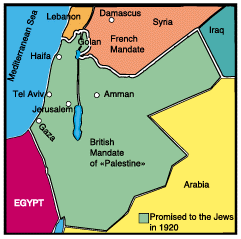
Area of Mandate Palestine

The original area of Palestine, for which the British Mandate was assigned, included Transjordan (what is today Jordan, on the eastern side of the Jordan River).

Credit: Hebroots
In September 1922, very soon after the League of Nations had adopted the Mandate resolution, Britain assigned TransJordan to Hashemite Arabs from Saudi Arabia.  The Jewish part of the Mandate was thus reduced by over 70%.
Jews then had the right to settle anywhere in a 10,000 sq.mi. area between the Jordan River and the Mediterranean Sea.

Mandate Transfer to UN:

With the formal demise of the League of Nations in 1946, the United Nations was established to succeed it.  The UN assumed obligations of the League: Territories under Mandate were to have a “trusteeship system” applied — this was a continuation of the Mandate system of the League.
Article 80 of the UN declared that “nothing in the [UN] Charter shall be construed…to alter in any manner the rights whatsoever of any states or peoples or the terms of existing international instruments.”  This preserved the Jewish right to settle in Palestine.

Violence in Palestine:

From the time of the establishment of the Mandate for Palestine, Arab challenges to it were considerable,  and were often expressed violently.  This was in spite of the fact at that the same that the Mandate for Palestine was established for the Jewish homeland, Mandates for Syria, Lebanon and Iraq were established, all for Arab populations.  Arabs were, and still are, offended by the presence of a Jewish state.
Perhaps most grievous of all was the Hebron massacre of 1929: for three days Arabs went on a murderous rampage in the city, killing 67 Jews and destroying property. In the aftermath, the second holiest city of the Jews was left bereft of Jews for the first time in hundreds of years.  (Ultimately the British prevented Jews from living in the city because they said they couldn’t protect them.)

Partition of Palestine:

In 1947, the British, who no longer wished to contend with the situation, declared intention to pull out by mid-1948, and turned the Mandate back to the United Nations. A UN Commission considered the matter and recommended a partition of Palestine into one state for the Jews and one for the Arabs, with Jerusalem to be internationalized at first.

Credit: Wikipedia
This recommendation was placed before the General Assembly as Resolution 181, which was adopted on November 29, 1947 by a vote of 33 to 12, with 10 abstentions. The Arab nations voted as a bloc against.
It is imperative to note that General Assembly Resolutions carry no weight in international law.  This resolution was only a recommendation — it was not binding and it did not supersede the Mandate for Palestine in international law.
Legally, this plan would have had binding force only as an agreement between the two parties, i.e., the Jews of Palestine and the Arabs of Palestine.
However, while the Jewish population of Palestinian accepted the proposal, the Arab population did not: they rejected the entire resolution.  Thus the partition plan was aborted.
There is no way for Arabs today to re-instate this resolution or to claim that Jews have a right to only what was defined as a Jewish state by this aborted resolution.

Declaration of the Establishment of the State of Israel:

On May 14, 1948 (Hebrew date: 5th of Iyar 5708), the Jewish People’s Council gathered at the Tel Aviv Museum, and approved a proclamation, declaring the establishment of the State of Israel.
It asserted the natural right of the Jewish people to be like all other peoples, exercising self-determination in its sovereign state and proclaimed the establishment of a Jewish state named “the State of Israel.”
It is important to note that Israel’s legal legitimacy did not derive from the aborted partition plan — even though the state was founded on that portion of Palestine that Resolution 181 had allocated for a Jewish state.
It was established according to international norms: based on a declaration of independence by its people and on the establishment of an orderly government within territory under its stable control.
The portion of Palestine on which Israel was not established became unclaimed Mandate land.  Nothing in international law had superseded the status of this land as Mandate land.

War of Independence

Within a day of the establishment of the State of Israel, it was attacked by the states of the Arab League, with clear, openly stated, intention of destroying the new state.
When the war ended in 1949, Israel controlled more territory than it had when independence was declared.  Egypt controlled Gaza, and Jordan controlled Judea and Samaria (the West Bank).  Western Jerusalem was in Israel’s hands, and eastern Jerusalem in Jordan’s hands.

Credit: buildersofzion
Armistice agreements were signed between Israel and the Arab states with which it had been at war.  Armistice lines — temporary ceasefire lines — were defined by these agreements.  They are often referred to as the Green Line.
These armistice demarcation lines did not define a permanent border for Israel. The agreement between Israel and Jordan includes this phrase:
“The Armistice Demarcation Lines defined…in this Agreement are agreed upon by the Parties without prejudice to future territorial settlements or boundary lines…”
This is exceedingly important because the PLO/PA claims that this line is Israel’s “real” border and the line to which it must withdraw.  This is simply not the case.

Six Day War

From June 5 to June 10, 1967, Israel fought a defensive war against Arab forces from Egypt, Syria and Jordan.
When it was over, Israel had control of all of Jerusalem, which was united under Israeli sovereignty; the Golan Heights, to which Israeli civil law was applied; the Sinai, which was surrendered as part of the 1979 peace treaty with Egypt; Gaza, which was surrendered in the 2005 disengagement; and Judea and Samaria.

242

In November 1967, the Security Council adopted Resolution 242, which addressed the situation.
This resolution did not require Israel to withdraw to the Green Line.  Instead it acknowledged the right of every state in the area “to live in peace within secure and recognized boundaries free from threats or acts of force.”
Implicit here was the understanding that the Green Line did not represent a secure boundary.  Israel suffered from a lack of strategic depth within the Green Line — at its narrowest only nine miles wide — which invited attack and made defense in war time difficult. (This is why Israeli statesman Abba Eban referred to the Green Line as the “Auschwitz borders.”)
Thus this resolution called for Israel to withdraw from “territories occupied in the recent conflict.”  “Territories,” not “the territories” or “all territories,” meaning, withdrawal from some but not all of the area of Judea and Samaria.  There is a legal history of long debate over this wording, because of its significance.  Not full withdrawal because that would not leave Israel with a secure boundary.
Once again, then, we see that the claim of the PLO/PA that Israel “must” withdraw to the Green Line is not supported by the facts.
Lastly, the resolution called for “a peaceful and accepted settlement in accordance with the provisions and principles in this resolution.”  That is, it called for negotiations to determine the final border of Israel.
There was no requirement that Israel withdraw prior to negotiations. And those negotiations have never been held.  At the time of this resolution, it was assumed that negotiations would be with Jordan.  Today the situation has changed.

“Occupation”

There is nothing in Resolution 242 that forbids construction of settlements in Judea and Samaria by Israel.  As this issue is a critical one now, we need to look at this a bit closer:
Israel is not an “occupier” in Judea and Samaria.
The word “occupation” is bandied about regularly.  The PA/PLO have adopted the idea of Israel as “occupier” as a mantra and much of the world has accepted it.  But the facts tell us something else.
  • Judea and Samaria were (and still are) unclaimed Mandate land, to which Israel has the strongest claim.
  • Legally, occupation only occurs when one nation moves into the land of another. But there was no nation legally sovereign in Judea and Samaria before 1967 — Jordan’s presence there was not legal
  • There are strong legal precedents for the claim that a war fought defensively permits retention of the land secured in that war.Wrote Steven Schwiebel, former judge of the International Court of Justice:
  • “…the Israeli conquest of Arab and Arab-held territory was defensive rather than aggressive conquest.
    “…it follows that modifications of the 1949 armistice lines.. are lawful…whether those modifications are, in Secretary Rogers’s words, ‘insubstantial alterations required for mutual security’ or more substantial alterations – such as recognition of Israeli sovereignty over the whole of Jerusalem.”

    • With all of the above, it should not be forgotten that areas over the Green Line, in eastern Jerusalem and Judea and Samaria, represent the very heart of Jewish heritage:  From the Temple Mount; to Hevron and the Cave of Machpelah, where the matriarch and patriarchs are buried; to Shilo, where the Tabernacle was brought.  How can Jews be “occupiers” in their own ancient land?

International Law

People have the impression that “international law” is a firmly defined body of law.  In point of fact, while some international law is established in formal documents, others aspects are very fluid.  Just as is the case with “occupation,” there is a tendency to politicize this term, so that Israel is forever accused of “violating international law.”  Be most cautious when hearing this.
There are, as well, instances in which “international law” is interpreted to mean one thing for Israel and another for other countries.
One fascinating example has to do with the Fourth Geneva Convention, Article 49(6), which says “the Occupying Power shall not deport or transfer parts of its own civilian population into the territory it occupies.”  You may have heard accusations that Israel is in defiance of this Article because of the “settlers.”
There are two obvious retorts to this: First, that Israel is not an occupier, and second, that Israel is not deporting or transferring parts of its own civilian population — the people go of their own volition.
Eugene Kontorovich, however, is currently doing research for a paper and has discovered something else:  There are many instances of movement of civilian population into occupied territory.  However, while international lawyers claim that Israel must actively oppose civilian migration, refuse to provide services to settlers, etc., in these other instances the reaction is much more tempered.  That is, the presumed requirements of “international law” are applied selectively to Israel.


5 REASONS WHY ISRAEL IS ONE OF THE WORLD’S MOST SUCCESSFUL STATES

The nation of Israel is often held up by cuckservatives and Jews as an example of a country that has succeeded in the face of overwhelming odds. Despite being surrounded by hostile states, repeatedly being invaded by their neighbors, and lacking oil deposits like other Middle Eastern nations, the Israelis have built their country into one of the most economically powerful and stable states in the world.

Why does Israel continue to prosper while other Western nations collapse? The answer is because the Israeli government puts the interests of its citizens first. Israelis are strongly nationalistic and their country’s leadership chooses its policies based on how they will benefit native citizens, as opposed to other Western nations that kowtow to the golden calves of diversity and multiculturalism. Here are the reasons why Israel is so successful, and what the rest of the West can learn from them…

1. Israel actively works to ensure that Jews will remain a majority

3294343349
You’ll often hear leftists cheering (and cuckservatives lamenting) the fact that many Western nations will soon have majority non-white populations. For example, Gregor Gysi, a prominent far-left Jewish politician in Germany, has referred to native Germans as “Nazis”and said that their inability to have offspring is “fortunate.” Leftist and cuckservative politicians in the U.S. and elsewhere justify their support for mass immigration on the basis that importing large numbers of foreigners is the only way to compensate for falling native birthrates.
Israel was explicitly founded as a homeland for the Jewish people and its government has worked to ensure that it remains one. For example, only Jews are allowed to immigrate to Israel and become citizens, a process referred to as “aliyah” (Hebrew for “ascent”). Not only does Israel have zero tolerance for illegal immigration, the government has also constructed border walls along the West Bank and Egyptian borders to deter invaders, and the country is also home to the world’s largest illegal alien detention facility.
Israeli Prime Minister Benjamin Netanyahu has also flatly refused to accept Syrian refugees, despite the fact that not only does his nation share a land border with Syria, Israel has been illegally occupying Syrian territory—the Golan Heights—for nearly fifty years.
Not only does Israel fight to keep non-Jews from immigrating, but the government also incentivizes its native citizens to marry and have children in order to keep the nation’s Arab minority from gaining demographic ground. Israel’s fertility rate is one of the highest in the developed world, at 3.04 babies per woman; the Jewish birthrate in Israel has skyrocketed in the past decade while the Arab birthrate has fallen.
Additionally, Israel takes active steps to prevent people living on public assistance and other undesirable groups from having children. For example, the government requires African Jewish migrants to take Depo-Provera shots as a condition for immigrating and accepting welfare. Israel is so adamant about maintaining its status as a Jewish-majority nation that it forbids Jews from marrying non-Jews, and the government even discourages Jewish women from dating Arab men.

2. Israel requires its citizens to serve in the military

idf
Because Israel is surrounded by hostile states who have repeatedly invaded it in the past, the Israelis maintain a strong tradition of mandatory military service. With few exceptions, all Israeli men are required to serve a minimum of three years in the Israeli Defense Forces; all women are required to serve two years. Ordinary Israelis may also be drafted to return to the military in times of invasion or other crises. Prime Minister Netanyahu also served in the military as a young man, in sharp contrast to President Obama:
netanyahu-obama
While the IDF is probably overrated as a fighting force—Israel’s humiliating defeat at the hands of Hezbollah during the 2006 Lebanon War being proof of this—the government’s commitment to mandatory military service is a boon to Israeli society. By requiring all citizens to serve in the IDF, Israel instills good values in its youth, gives them a stake in the country’s existence, and also keeps its populace combat-ready in the event of disaster.

3. Israel’s politicians support the country’s national interests

Benjamin_Netanyahu_2012
In most countries in the West, the major political parties are dominated by internationalists who agitate for more immigration, more “free trade” agreements, and more multiculturalism. Whether it’s the Democrats and the Republicans in the U.S., the Conservatives and Labour in the U.K., or the Conservatives, Liberals and NDP in Canada, the largest political parties are in basic agreement on the wonders of diversity and mass immigration.
In sharp contrast, Israel’s dominant political party, Likud, is unabashedly nationalist and puts Israel first. As I mentioned above, Prime Minister Benjamin Netanyahu has taken a hard-line against illegal immigration and Syrian refugees. He’s been rewarded with electoral victory after victory, and is on track to become Israel’s longest-serving prime minister ever, exceeding the tenure of David Ben-Gurion, Israel’s founder. Conversely, Israel’s major left-wing party, Labor, has been losing ground for the past decade.
Israel is also not shy about flexing its muscle on the international stage. The large number of diaspora Jews in the U.S.—as well as Dispensationalist evangelical Christians—enables Israel to have considerable sway over American politics. Israel collects large amounts of foreign aidfrom the U.S. despite having a wealthy, first-world economy, and American foreign policy is driven by our country’s “alliance” with Israel.
In short, the relationship between Israel and the U.S. is akin to that of a hot chick and her beta orbiter. Blaming Israelis for this is as dumb as blaming the aforementioned hot chick for accepting free gifts from said orbiters. Whatever you can say about Netanyahu and the Israeli government, you can’t argue that he doesn’t put his nation above all else.

4. Israel is patriarchal and allows men to marry and form families

l_haredim150713EN
Most Western countries have severely crippled the freedom of men to manage their wives and children with punitive, anti-male legislation and generous welfare policies. By rewarding women who get knocked up with government cheese, the U.S. and other countries areincentivizing single motherhood and disincentivizing the formation of nuclear families. It’s gotten so bad that in some countries, it’s considered “domestic abuse” if a man tries to keep his wife or girlfriend from wasting his money on frivolous purchases.
While Israel is not immune to the forces of sterility and subversion that are ruining the rest of the West—for example, Tel Aviv is known as the gay capital of the Middle East—Israeli society is among the most traditionalist and patriarchal in the West. In particular, Israel’s population growth is being driven by Orthodox Jews, who strictly adhere to traditional gender roles: the man is the head of the household, and the woman is expected to submit to him as a wife and mother. Orthodox Judaism is so patriarchal that women are barred from divorcing without their husbands’ permission.
Not only that, feminists have become increasingly vocal in their opposition to Israel, citing the government’s mistreatment of Palestinians as a reason. Left-wing forces as a whole have sympathized with the Palestinian plight for years, with anti-Zionist activists calling for a boycott of Israeli products and divestment from the country itself, much in the same way the international community did to South Africa during the apartheid years.

5. Israeli society places religion front and center

western-wall
Return of Kings publisher Roosh and other commentators have pointed to the death of Christianity as a major reason for the West’s decline. Without a religious and moral framework to guide society, people inevitably descend into mindless hedonism and degeneracy. While it’s debatable whether a Christian renaissance in the West is even possible, there’s no denying that Christianity provided innumerable benefits to America and other nations.
As mentioned above, Israel fervently defends its status as a Jewish homeland, and this includes emphasizing Judaism’s religious aspects. God and religion are inescapable aspects of everyday life in Israel, and ultra-Orthodox minorities such as the Hasidim are growing in both numbers and prominence. Some Israelis are so fanatical about their Jewishness that they openly call for Christian missionaries to be banned from the country.
As you can see, Israel’s success as a nation is due to the fact that it rejects many of the trends that dominate the rest of the West. While the U.S., Canada, Britain and other countries are eagerly greasing the slide to Gomorrah, Israelis continue to venerate God, the patriarchal family, and nationalism. This is even more striking when you consider that Israelis co-exist with a hostile, antagonistic population in their midst: the Palestinians.
Regardless of how you feel about Israel as a nation or about the Israeli-Palestinian conflict, there is no denying that the West has much to learn from their successes. By resisting the cultural Marxism that has gripped much of humanity, Israel has given itself a strong chance of survival in the future. America would do well to emulate some of what Israel is doing if she hopes to become great again.

Israeli's Land Rights Legal


Israel’s Legal Rights to the Land


Are the Settlements Legal? is a consolidation of two articles by Eugene W. Rostow, former US Assistant Secretary of State (1966-1969) and former Dean of the Yale Law School. The articles appeared in The New Republic on April 23, 1990 and October 21, 1991. With varying degrees of seriousness, all American administrations since 1967 have objected to Israeli settlements in the West Bank (Judea and Samaria) on the ground that it would make it more difficult to persuade the Arabs to make peace. President Carter decreed that the settlements were “illegal” as well as tactically unwise. President Reagan said the settlements were legal but that they made negotiations less likely . . . . (United Nations) Security Council Resolutions 242 and 338. Resolution 242, adopted after the Six Day War in 1967, set out criteria for peace-making by the parties (to the conflict); Resolution 338, passed after the Yom Kippur War in 1973, makes resolution 242 legally binding and orders the parties to carry out its terms forthwith. Unfortunately, confusion reigns, even in high places, about what those resolutions require. (Since 1967) Arab states have pretended that the two resolutions are “ambiguous” and can be interpreted to suit their desires. And some Europeans (Russian) and even American officials have cynically allowed

First settlers arriving at Ein Tzurim in 1946.

Migdal Eder — Founded by Yeminite Jews in 1927. Destroyed during the riots of 1929.
Arab spokesmen to delude themselves and their p eople—to say nothing of Western public opinion — about what the resolutions mean. It is common even for American journalists to write that Resolution 242 is “deliberately ambiguous,” as if the parties are equally free to rely on their own reading of its key provisions. Nothing could be further from the truth. Resolution 242, which as Under Secretary of State for Political Affairs between 1966 and 1969, I [Eugene W. Rostow] helped produce, calls on the parties to make peace and allows Israel to administer the territories it occupied in 1967 until “a just and lasting peace in the Middle East” is achieved. When such a peace is made, Israel is required to withdraw it s armed forces “from territories” that it occupied during the Six Day War—not from “the” territories, nor from “all” the territories, but some of the territories, which included the Sinai Desert, the West Bank, the Golan Heights, East Jerusalem, and the Gaza Strip. Five and a half months of vehement public diplomacy made it perfectly clear what the missing definite article in Resolution 242 means. Ingeniously drafted resolutions calling for withdrawals from “all” the territories were defeated in the Security Council and the General Assembly. Speaker after speaker made it explicit that Israel was not to be forced back to the “fragile” and “vulnerable” Armistice Demarcation Lines, but should retire once peace was made to what Resolution 242 called “secure and recognized” boundaries agreed to by the parties. In negotiating such agreement, the parties should take into account, among other factors, security considerations, access to the international waterways of the region, and, of course, their respective legal claims. Resolution 242 built on the text of the Armistice Agreements of 1949, ...provided (except in the case of Lebanon) that the Armistice Demarcation Lines separating the military forces were “not to be construed in any sense” as political or territorial boundaries, and that “no provision” of the Armistice Agreements “shall in any way prejudice the right, claims, and positions” of the parties “in the ultimate peaceful settlement of the Palestine problem.” In making peace with Egypt in 1979, Israel withdrew from the entire Sinai, which had never been part of the British Mandate. The heated question of Israel’s settlements in the West Bank during the occupation period should be viewed in this perspective. The British Mandate recognized the right of the Jewish People to “close settlement” in the whole of the Mandated territory. It was provided that local conditions might require Great Britain to “postpone” or “withhold” Jewish settlement in what is now Jordan. This was done in 1922. But the Jewish right of settlement in Palestine, west of the Jordan River, that is in Israel, the West Bank, Jerusalem, and the Gaza Strip, was made unassailable. That right has never been terminated, and cannot be terminated except by a recognized peace between Israel and its neighbors. And perhaps not even then, in view of Article 80 of the UN Charter, “the Palestine Article,” which provides that nothing in the Charter shall be construed “to alter in any manner the rights whatsoever of any states or any peoples or the terms of existing international instruments . . . .” Some governments have taken the view that under the Geneva Convention of 1949, which deals with the rights of civilians under military occupation, Jewish settlements in the West Bank are illegal, on the ground that the Convention prohibits an occupying power from floodin g the occupied territory with its own citizens. President Carter supported this view, but President Reagan reversed him, specifically saying that the settlements are legal but that further settlements should be deferred since they pose an obstacle to the peace process . . . . The Jewish right of settlement in the West Bank is conferred by the same provisions of the Mandate under which Jews settled in Haifa, Tel Aviv, and Jerusalem before the State of Israel was created. The Mandate for Palestine differs in one important respect from the other League of N ations mandates, which were trusts for the benefit of the indigenous population. The Palestine Mandate, recognizing “the historical connection of the Jewish People with Palestine, and the grounds for reconstituting their national home in that country,” is dedicated to “the establishment in Palestine of a national home for the Jewish people, it being clearly understood that nothing sh ould be done which might prejudice the civil and religious rights of existing non-Jewish communities in Palestine, or the rights and political status enjoyed by Jews in any other country.” The Mandate qualifies the Jewish right of settlement and political development in Palestine in only one respect. Article 25 gave Great Britain and the League Council discretion to “postpone” or “withhold” the Jewish People’s right of settlement in the Trans-Jordanian province of Palestine—now the Kingdom of Jordan—if they decided that local conditions made such action desirable. With the divided support of the council, the British took that step in 1922. The Mandate does not, however, permit even a temporary suspension of the Jewish right of settlem ent in the parts of the Mandate west of the Jordan River. The Armistice Lines of 1949, which are part of the West Bank boundary, represent nothing but the position of the contending armies when the final cease-fire was achieved in the War of Independence. And the Armistice Agreements specifically provide, except in the case of Lebanon, that the demarcation lines can be changed by agreement when the parties move from Armistice to peace. Resolution 242 is based on that provision of the Armistice Agreements and states certain criteria that would justify changes in the demarcation lines when the parties make peace . . . . The State Department has never denied that under the Mandate “the Jewish people” have the right to settle in the area. Instead, it said that Jewish settlements in the West Bank violate Article 49 of the 4th Geneva Convention of 1949, which deals with the protection of civilians in w artime. Where the territory of one contracting party is occupied by another contracting party, the convention prohibits many of the inhumane practices of the Nazis and the Soviets before and during the Second World War—th e mass transfer of people into or out of occupied territories for purposes of extermination, slave labor or colonization, for exampl e. Article 49 provides that the occupying power “shall not deport or transfer part of its own civilian population into the territory it occupies.” But the Jewish settlers in the West Bank are volunteers. They have not been “deported” or “transferred” by th e government of Israel, an d their movement involves none of the atrocious purposes or harmful effects on the existing population the Geneva Convention was designed to prevent. Furtherm ore, the Convention applies only to “acts by one signatory carried out on the territory of another.” The West Bank is not the territory of a signatory power, but an unallocated part of the British Mandate. It is hard, therefore, to see how even the most literal minded reading of the Convention could make it apply to Jewish settlement in territories of the British Mandate west of the Jordan River. Even if the Convention could be construed to prevent settlements during the period of occupation, it could do no more than suspend, not terminate, the rights conferred by the Mandate. Those rights can be ended only by the establishment and recognition of a new state or the incorporation of the territories into an old one. As claimants to the territory the Israelis have denied that they are required to comply with the Geneva Convention but announced that they will do so as a matter of grace. The Israeli courts apply the Convention routinely, sometimes deciding against the Israeli Government. Assuming for the moment the general applicability of the Convention, it could well be considered a violation if the Israelis deported convicts to the area, or encouraged the settlement of people who had no right to live there (Americans for example). But how can the Convention be deemed to apply to Jews who have a right to settle in the territories under international law: a legal right assured by treaty and specifically protected by Article 80 of the UN Charter, which provides that nothing in the Charter shall be construed “to alter in any manner rights conferred by existing international instruments.” The Jewish right of settlement in the area is equivalent in every way to the right of the existing Palestinian population to live there . . . . The general expectation of international law is that military occupations last a short time, and are succeeded by a state of peace established by treaty or otherwise. In the case of the West Bank the territory was occupied by Jordan between 1949 and 1967 and has been occupied by Israel since 1967. Security Council Resolutions 242 and 338 ruled that the Arab states and Israel must make peace, and that when “a just and lasting peace” is reached in the Middle East, Israel should withdraw from some but not all of the territory it occupied in the course of the 1967 war. The Resolutions leave it to the parties to agree on the terms of peace.


Israeli's Land Rights Historical


Israel’s Historical Rights to the Land

Aliyah!


Jews lived in their Land virtually uninterrupted for 1,700 years until Rome destroyed Israel’s polity in CE 70 and CE 135. The archeological discovery of the Merneptah Stela which describes an attack on ancient Israel confirms Israel’s ancient presence in the Land. By CE 70, Josephus, the Roman Emperor’s official historian, observed that 4-7 million Jews dwelt in Israel. (Wars VI, 420, 425). Roman slaughter and expulsion decimated these Jewish inhabitants. Then Christian, Persian, Arab, Crusader, Mameluke and Turkish armies devastated the Holy Land and ruled temporarily. Still some Jews clung to their Land. Jews have been the continuous indigenous people of the Holy Land for about 3,600 years. Arabs ruled the Holy Land for only 22 years during the period C E 633-1099. (Syrian Delegation to Paris Peace Conference, Feb. 1919.) The Arab historian Ibn Khaldun observed that as late as CE 1400 the Land was permeated with Jewish culture. Over 300 years after Arab rule ended, there was still no evidence of Arab Palestinian roots or established culture. T hus, the noted Arab historian denies the false claim of an uninterrupted Palestinian culture dating back to CE 636. James Parkes in his Whose Land? states, “It is not until the Turkish period, CE 1517-1917, that in the ethnic sense it [the Holy Land] acquired a substantial Arab, [though] not majority, population….” How? By immigration, not by natural population growth. At the same time (CE 1561) Sultan Suleiman, a Muslim, granted Joseph Nasi the right to found the “kernel of a JewishState” in Tiberias and seven villages surrounded by a wall (Germany, Turkey, Zionism, 1897-1918 p.22). As a result thousands of Jews immigrated to the Land in a wave of Messianic fervor. In the 1700s and 1800s noted travelers observed the Holy Land was a barren waste. Its greatest lack was a “body of population.” Finally, the Biblical ingathering of the Jewish exiles began. (Jeremiah 16:14,15) This triggered a large Arab immigration hoping to benefit from the growing Jewish economy. Both British Prime Minister MacDonald and President Roosevelt confirmed that this was the reason for the flood of Arab immigration since 1918. To defend British policy, the not overly-Jewish-friendly British Secretary of State for the colonies, Malcolm MacDonald, declared in the House of Commons (November 24, 1938): “The Arabs cannot say that the Jews are driving them out of the country. If not a single Jew had come to Palestine after 1918, I believe the Arab population of Palestine would still have been around 600,000....” Jewish contributions and Jewish immigration continued to flow into the Land. The Jews created industry, agriculture, hospitals—a complete socio-economic infrastructure. As job opportunities increased, so did Arab immigration. In fact, in 1939 President Roosevelt observed that “Arab immigration into Palestine since 1921 has vastly exceeded the total Jewish immigration during this whole period.” For one specific example, i n 1934 between 30,000 and 36,000 Arabs from the Hauran Province in Syria left for “the better life” in Palestine. The flood continued until 1948. Some writers claim that 75 percent of the Arab population was either immigrants into the Holy Land after 1882 or their descendants (Justice For My People, 1943, p. 130). Tens of thousands of Arabs were entering to obtain a better life. Town Names Betray Their True History Yoram Ettinger, a former liaison for Congressional affairs in Israel’s Washington embassy, lists evidence showing that Judea and Samaria has Jewish, not Arab, roots. He says almost all Arab localities in Judea and Samaria have retained Biblical Jewish names, reaffirming their Jewish roots. Examples include the following:


  • A Anata is the biblical and contemporary Anatot, the dwelling of the Prophet Jeremiah.
  •  A Batir is the biblical and contemporary Beitar, the headquarters of Bar Kochba, the leader of the Great Rebellion against the Roman Empire, which was suppressed in 135 CE.
  •  A Beit-Hur is the biblical and contemporary Beit Horon, site of Judah the Maccabee’s victory over the Assyrians.
  • A Beitin is the biblical and contemporary Beit El, a site of the Holy Ark and Prophet Samuel’s court. A Bethlehem is mentioned 44 times in the Bible and is the birth place of King David.
  •  A Beit Jalla is the biblical and contemporary Gilo, in southern Jerusalem, where Sennacherib set his camp while besieging Jerusalem. A El-Jib is the biblical and contemporary Gibeon, Joshua’s battleground known for his command to stop the sun and moon (Joshua 10:12).
  •  A Jaba’ is the biblical and contemporary Geva, site of King Saul’s son Jonathan’s victory over the Philistines. A Jenin is the biblical and contemporary Ein Ganim, a Levite town within the tribe of Issachar.
  •  A Mukhmas is the biblical and contemporary Mikhmash, residence of Jonathan the Maccabee and site of King Saul’s fortress. 
  • A Seilun is the biblical and contemporary Shilo, a site of Joshua’s tabernacle and the Holy Ark and Samuel’s youth.
  •  A Tequa is the biblical and contemporary Tekoa, hometow n of the Prophet Amos.

The Palestinian Claim The Palestinian claim that the Land for centuries sustained a thriving Palestinian culture is not authorized by the facts of histor y. Yet the world community has given this claim a receptive hearing. PLO Chairman Yassir Arafat in his speech before the U.N. in 1974 declared, “The Jewish invasion began in 1881... Palestine was then a verdant area, inhabited mainly by an Arab people in the course of building its life and dynamically enrichin g its indigenous culture.” What happens when this claim is compared with the personal observations of the following recognized authorities? In 1738 Thomas Shaw observed a land of “barrenness...from want of inhabitants.” In 1785 Constantine Francois de Volney recorded the population of the three main cities. Jerusalem had a population of 12,000 to 14,000. Bethlehem had about 600 able-bodied men. Hebron had 800 to 900 men. In 1835 Alphonse de Lamartine wrote, “Outside the city of Jerusalem, we saw no living object, heard no living sound... a complete eternal silence reigns in the town, in the highways, in the country....the tomb of a whole people.” In 1857 the British consul in Palestine, James Finn, reported, “The country is in a considerable degree empty of inhabitants and therefore its greatest need is that of a body of population.” This historic observation is a remarkable confirmation of the Biblical predictions that during Israel’s “double” period of punishment and dispersion, the Lord would cause the Land to become desolate of man and beast (Jeremiah 33:10; Zechariah 9:12; Jeremiah 16:14-18). No wonder by 1857 it was just waiting for “a body of population”! In the Lord’s providence this needed body of population —the Jewish people—began to return after 1878 at the end of their Scriptural period of God’s disfavor. (See the following wasteland pictures from 1862-1920.) The most popular quote on the desolation of the Land is from Mark Twain’s THE INNOCENTS ABROAD (1867):

Esdraelon Valley—1894


Tel Aviv—1909

Genneseret—1890


“Palestine sits in sackcloth and ashes. Over it broods the spell of a curse that has withered its fields and fettered its energies....Palestine is desolate and unlovely....It is a hopeless, dreary, heartbroken land.” The records of history confirm the Biblical predictions that during the Jewish dispersion and “double” of God’s disfavor, the Land of Israel would become desolate awaiting the return of the Jewish people when its period of disfavor ended in 1878. The records of history simply do not confirm today’s Palestinian claim of Palestinian roots and culture in a “verdant area” since the Arab rule of the Land (CE 640-1099). Southern Syria vs. “Palestine” The Romans changed the name of the Land of Israel to “Palestine.” But from CE 640 until the 1960s, Arabs referred to this same Land as “Southern Syria.” Arabs only began calling the Land “Palestine” in the 1960s. Until about the eighteenth century, the Christian world called this same Land, “The Holy Land.” Thereafter, they used two names: “The Holy Land” and “Palestine.” In 1922 when the League of Nations gave Great Britain the mandate to prepare Palestine as a national home for the Jewish people, the official name of the Land became “Palestine” and remained so until the rebirth of the Israeli State in 1948. However, during this very period, the leaders of the Arabs in the Land called themselves Southern Syrians and clamored that the Land become a part of a “Greater Syria.” This “Arab Nation” would include Syria, Lebanon, Iraq, and Transjordan as well as Palestine. An observation in Time magazine well articulated how the Palestinian identity was born so belatedly in the 1960s: Golda Meir once argued that there was no such thing as a Palestinian; at the time, she wasn’t entirely wrong. Before Arafat began his proselytizing, most of the Arabs from the territory of Palestine thought of themselves as members of an all-embracing Arab nation. It was Arafat who madethe intellectual leap to a definition of the Palestinians as a distinct people; he articulated the cause, organized for it, fought for it and brought it to the world’s attention. . . . If there had been an Arab Palestinian culture, a normal population increase over the centuries would have been expected. But, with the exception of a relatively few families, the Arabs had no attachment to the Land. If Arabs from southern Syria drifted into Palestine for economic reasons, within a generation or so the cultural tug of Syria or other Arab lands would pull them back. This factor is why the Arab population average remained low until the influx of Jewish financial investments and Jewish people in the late 1800s made the Land economically attractive. Then sometime between 1850 and 1918, the Arab population shot up to 560,000. On the other hand, Great Britain’s White Paper of 1939 closed the doors of Jewish immigration to their Land. Simultaneously, there was a large-scale Arab immigration to the new Land of opportunity during World War II. In 1946 Bartley C. Crum, a United States Government observer, noted that tens of thousands of Arabs had entered Palestine “because of this better life—and they were still coming.” The Testimony of Arabs and Christians Because Arabs until the 1960s spoke of Palestine as Southern Syria or part of Greater Syria, in 1919 the General Syrian Congress stated, “We ask that there should be no separation of the southern part of Syria, known as Palestine.” In 1939 George Antonius noted the Arab view of Palestine in 1918: Faisal’s views about the future of Palestine did not differ from those of his father and were identical with those held then by the great majority of politically-minded Arabs. The representative Arab view was substantially that which King Husain [Grand Sherif of Mecca, the great grandfather of the current King Hussein of Jordan]had expressed to the British Government...in January 1918. In the Arab view, Palestine was an Arab territory forming an integral part of Syria. Referring to the same Arab view of Palestine in 1939, George Antonius spoke of “the whole of the country of that name [Syria] which is now split up into mandated territories....” His lament was that France’s mandate over Syria did not include Palestine which was under Britain’s mandate. As late as May 1947, Arab representatives reminded the United Nations in a formal statement, “Palestine is a...part of the Province of Syria....Politically, the Arabs of Palestine were not independent in the sense of forming a separate political entity.” On May 31, 1956, Ahmed Shukairy had no hesitation, as current head of the Palestine Liberation Organization, in announcing to the Security Council the observation, “It is common knowledge that Palestine is nothing but southern Syria.” Syrian President Hafez Assad once told PLO leader Yassir Arafat: You do not represent Palestine as much as we do. Never forget this one point: There is no such thing as a Palestinian People, there is no Palestinian entity, there is only Syria. You are an integral part of the Syrian People, Palestine is an integral part of Syria. Therefore it is we, the Syrian authorities, who are the true representatives of the Palestinian people. Assad stated on March 8, 1974, “Palestine is a principal part of Southern Syria, and we consider that it is our right and duty to insist that it be a liberated partner of our Arab homeland and of Syria.” In the words of the late military commander of the PLO as well as member of the PLO Executive Council, Zuhair Muhsin:There are no differences between Jordanians, Palestinians, Syrians and Lebanese. We are all part of one nation. It is only for political reasons that we carefully underline our Palestinian identity….yes, the existence of a separate Palestinian identity serves only tactical purposes. The founding of a Palestinian state is a new tool in the continuing battle against Israel [emphasis ours]. The most authoritative Arab statement, however, as to whom the Holy Land belongs is found in the Koran, the Islamic Scriptures. The fact is that the Koran agrees with the Bible that God (Allah) made a covenant with the Sons of Israel and assigned the Holy Land to the Jews (see the Koran, Sura V, “The Table”). The Koran also describes the Land given to the Jews as “blessed” and foresees a return of Israel to their Land at the end of days. These testimonies confirm the Christian Scriptures that God gave the Land to the Jewish people as an everlasting possession. The relatively few Arabs who wandered into the Land between CE 670-1878 were but temporary dwellers. The truer perspective of history reveals that the large recent influx of Arabs that paralleled the regathering of Jews has no historic roots in the Land. The Verdict of History: Land Rights Before Jewish immigration and Jewish investments spawned massive Arab immigration, Arabs were actually leaving Palestine. Then the flow of traffic reversed. “...Palestine changed from a country of Arab emigration to one of Arab immigration. Arabs from the Hauran in Syria as well as other neighboring lands poured into Palestine to profit from the higher standard of living and fresh opportunities provided by the Zionist pioneers.” This phenomenon is confirmed by the Palestine Royal Commission Report which observed that in the period between the Balfour Declaration and the United Nations Partition Resolution of 1947, Palestine became a land of Arab immigration. As further documented by Ernst Frankenstein, substantial Arab immigration was a recent phenomenon: The early “lovers of Zion” began the stimulation of Arab immigration. Some writers have come out with the conclusion that in 1942, 75 percent of the Arab population were either immigrants or descendants of immigrants into Palestine during the preceding one hundred years, mainly after 1882. WHOSE LAND? The Arabs ruled the Land for less than 100 years. The Jews ruled the Land of Israel for over 1,700 years. The testimony of history proves the Jewish people are the historic people of the land, therefore the Land still belongs to them. Regardless of the peace process, the Judeo-Christian Bible (Isaiah 2:2,3) and Muslim Koran (Sura 17:104), predict the Jewish people will yet peacefully enjoy the right to all their Land.