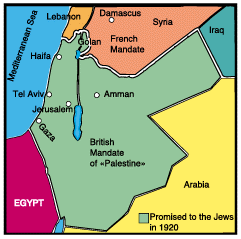
At San Remo it was decided to incorporate the Balfour Declaration into Britain’s mandate. The Declaration, in the form of a letter, was an endorsement by the British government of the establishment of a Jewish home in Palestine. Written in 1917 by the British Foreign Secretary Lord Balfour, and sent to Lord Rothschild, it stated:
“His Majesty’s Government view with favour the establishment in Palestine of a national home for the Jewish people, , and will use their best endeavors to facilitate the achievement of this object.”
By “Right”:
In June 1922, Winston Churchill, who was then British Secretary of State for the Colonies, wrote in a policy paper that:
“…in order that this community should have the best prospect of free development and provide a full opportunity for the Jewish people to display its capacities, it is essential that it should know that it is in Palestine as of right and not on sufferance.”
League of Nations Formalizes Mandate:
In July 1922, the League of Nations, predecessor to the UN, formally adopted the British Mandate for Palestine — a legally binding document that was approved by all 51 members of the League of Nations.
It agreed that:
“the Mandatory [Britain] should be responsible for putting into effect the declaration originally made on November 2nd, 1917 [Balfour Declaration], by the Government of His Britannic Majesty, and adopted by the said Powers, in favor of the establishment in Palestine of a national home for the Jewish people…”
And it gave recognition to:
“the historical connection of the Jewish people with Palestine and to the grounds for reconstituting their national home in that country.”
The term “reconstituting” gave acknowledgement to the fact that there had been a Jewish nation in Palestine at an earlier time.
“Mandate” Explained
The mandatory system of the League of Nations was based on the principle of Allied administration of Mandate territories until such time as they were able to stand alone. That is, it was understood at the beginning that the British would ultimately withdraw, leaving an established Jewish homeland.
Area of Mandate Palestine
The original area of Palestine, for which the British Mandate was assigned, included Transjordan (what is today Jordan, on the eastern side of the Jordan River).

Credit: Hebroots
In September 1922, very soon after the League of Nations had adopted the Mandate resolution, Britain assigned TransJordan to Hashemite Arabs from Saudi Arabia. The Jewish part of the Mandate was thus reduced by over 70%.
Jews then had the right to settle anywhere in a 10,000 sq.mi. area between the Jordan River and the Mediterranean Sea.

Mandate Transfer to UN:
With the formal demise of the League of Nations in 1946, the United Nations was established to succeed it. The UN assumed obligations of the League: Territories under Mandate were to have a “trusteeship system” applied — this was a continuation of the Mandate system of the League.
Article 80 of the UN declared that “nothing in the [UN] Charter shall be construed…to alter in any manner the rights whatsoever of any states or peoples or the terms of existing international instruments.” This preserved the Jewish right to settle in Palestine.
Violence in Palestine:
From the time of the establishment of the Mandate for Palestine, Arab challenges to it were considerable, and were often expressed violently. This was in spite of the fact at that the same that the Mandate for Palestine was established for the Jewish homeland, Mandates for Syria, Lebanon and Iraq were established, all for Arab populations. Arabs were, and still are, offended by the presence of a Jewish state.
Partition of Palestine:
In 1947, the British, who no longer wished to contend with the situation, declared intention to pull out by mid-1948, and turned the Mandate back to the United Nations. A UN Commission considered the matter and recommended a partition of Palestine into one state for the Jews and one for the Arabs, with Jerusalem to be internationalized at first.

Credit: Wikipedia
This recommendation was placed before the General Assembly as Resolution 181, which was adopted on November 29, 1947 by a vote of 33 to 12, with 10 abstentions. The Arab nations voted as a bloc against.
It is imperative to note that General Assembly Resolutions carry no weight in international law. This resolution was only a recommendation — it was not binding and it did not supersede the Mandate for Palestine in international law.
Legally, this plan would have had binding force only as an agreement between the two parties, i.e., the Jews of Palestine and the Arabs of Palestine.
However, while the Jewish population of Palestinian accepted the proposal, the Arab population did not: they rejected the entire resolution. Thus the partition plan was aborted.
There is no way for Arabs today to re-instate this resolution or to claim that Jews have a right to only what was defined as a Jewish state by this aborted resolution.
Declaration of the Establishment of the State of Israel:
On May 14, 1948 (Hebrew date: 5th of Iyar 5708), the Jewish People’s Council gathered at the Tel Aviv Museum, and approved a proclamation, declaring the establishment of the State of Israel.
It asserted the natural right of the Jewish people to be like all other peoples, exercising self-determination in its sovereign state and proclaimed the establishment of a Jewish state named “the State of Israel.”
It is important to note that Israel’s legal legitimacy did not derive from the aborted partition plan — even though the state was founded on that portion of Palestine that Resolution 181 had allocated for a Jewish state.
It was established according to international norms: based on a declaration of independence by its people and on the establishment of an orderly government within territory under its stable control.
The portion of Palestine on which Israel was not established became unclaimed Mandate land. Nothing in international law had superseded the status of this land as Mandate land.
War of Independence
Within a day of the establishment of the State of Israel, it was attacked by the states of the Arab League, with clear, openly stated, intention of destroying the new state.
When the war ended in 1949, Israel controlled more territory than it had when independence was declared. Egypt controlled Gaza, and Jordan controlled Judea and Samaria (the West Bank). Western Jerusalem was in Israel’s hands, and eastern Jerusalem in Jordan’s hands.

Credit: buildersofzion
Armistice agreements were signed between Israel and the Arab states with which it had been at war. Armistice lines — temporary ceasefire lines — were defined by these agreements. They are often referred to as the Green Line.
These armistice demarcation lines did not define a permanent border for Israel. The agreement between Israel and Jordan includes this phrase:
“The Armistice Demarcation Lines defined…in this Agreement are agreed upon by the Parties without prejudice to future territorial settlements or boundary lines…”
This is exceedingly important because the PLO/PA claims that this line is Israel’s “real” border and the line to which it must withdraw. This is simply not the case.
Six Day War
From June 5 to June 10, 1967, Israel fought a defensive war against Arab forces from Egypt, Syria and Jordan.
When it was over, Israel had control of all of Jerusalem, which was united under Israeli sovereignty; the Golan Heights, to which Israeli civil law was applied; the Sinai, which was surrendered as part of the 1979 peace treaty with Egypt; Gaza, which was surrendered in the 2005 disengagement; and Judea and Samaria.
242
In November 1967, the Security Council adopted Resolution 242, which addressed the situation.
This resolution did not require Israel to withdraw to the Green Line. Instead it acknowledged the right of every state in the area “to live in peace within secure and recognized boundaries free from threats or acts of force.”
Implicit here was the understanding that the Green Line did not represent a secure boundary. Israel suffered from a lack of strategic depth within the Green Line — at its narrowest only nine miles wide — which invited attack and made defense in war time difficult. (This is why Israeli statesman Abba Eban referred to the Green Line as the “Auschwitz borders.”)
Thus this resolution called for Israel to withdraw from “territories occupied in the recent conflict.” “Territories,” not “the territories” or “all territories,” meaning, withdrawal from some but not all of the area of Judea and Samaria. There is a legal history of long debate over this wording, because of its significance. Not full withdrawal because that would not leave Israel with a secure boundary.
Once again, then, we see that the claim of the PLO/PA that Israel “must” withdraw to the Green Line is not supported by the facts.
Lastly, the resolution called for “a peaceful and accepted settlement in accordance with the provisions and principles in this resolution.” That is, it called for negotiations to determine the final border of Israel.
There was no requirement that Israel withdraw prior to negotiations. And those negotiations have never been held. At the time of this resolution, it was assumed that negotiations would be with Jordan. Today the situation has changed.
“Occupation”
There is nothing in Resolution 242 that forbids construction of settlements in Judea and Samaria by Israel. As this issue is a critical one now, we need to look at this a bit closer:
Israel is not an “occupier” in Judea and Samaria.
The word “occupation” is bandied about regularly. The PA/PLO have adopted the idea of Israel as “occupier” as a mantra and much of the world has accepted it. But the facts tell us something else.
- Judea and Samaria were (and still are) unclaimed Mandate land, to which Israel has the strongest claim.
- Legally, occupation only occurs when one nation moves into the land of another. But there was no nation legally sovereign in Judea and Samaria before 1967 — Jordan’s presence there was not legal
- There are strong legal precedents for the claim that a war fought defensively permits retention of the land secured in that war.Wrote Steven Schwiebel, former judge of the International Court of Justice:
“…the Israeli conquest of Arab and Arab-held territory was defensive rather than aggressive conquest.
“…it follows that modifications of the 1949 armistice lines.. are lawful…whether those modifications are, in Secretary Rogers’s words, ‘insubstantial alterations required for mutual security’ or more substantial alterations – such as recognition of Israeli sovereignty over the whole of Jerusalem.”
- With all of the above, it should not be forgotten that areas over the Green Line, in eastern Jerusalem and Judea and Samaria, represent the very heart of Jewish heritage: From the Temple Mount; to Hevron and the Cave of Machpelah, where the matriarch and patriarchs are buried; to Shilo, where the Tabernacle was brought. How can Jews be “occupiers” in their own ancient land?
International Law
People have the impression that “international law” is a firmly defined body of law. In point of fact, while some international law is established in formal documents, others aspects are very fluid. Just as is the case with “occupation,” there is a tendency to politicize this term, so that Israel is forever accused of “violating international law.” Be most cautious when hearing this.
There are, as well, instances in which “international law” is interpreted to mean one thing for Israel and another for other countries.
One fascinating example has to do with the Fourth Geneva Convention, Article 49(6), which says “the Occupying Power shall not deport or transfer parts of its own civilian population into the territory it occupies.” You may have heard accusations that Israel is in defiance of this Article because of the “settlers.”
There are two obvious retorts to this: First, that Israel is not an occupier, and second, that Israel is not deporting or transferring parts of its own civilian population — the people go of their own volition.
Eugene Kontorovich, however, is currently doing research for a paper and has discovered something else: There are many instances of movement of civilian population into occupied territory. However, while international lawyers claim that Israel must actively oppose civilian migration, refuse to provide services to settlers, etc., in these other instances the reaction is much more tempered. That is, the presumed requirements of “international law” are applied selectively to Israel.