Showing posts with label Israeli's Land Rights Biblical. Show all posts

Ability to feed the population of the entire world-Eternal Capital Israel in Milennium

Israel proudly proclaims that they have the ability to feed the population of the entire world due to their advanced farming techniques. I  Israel

I will bless those who bless you, and I will curse him who curses you.
-Genesis 12:3
The fruits of blessing Israel will be worth it.


Glory Glory Glory to YHVH how glorious is His dwelling place....Yeshua HaMashiach How awesome are you even just to see your glorious awesome and wonderful creation I love you Lord,!!!!!May the people of Israel know your true the son of God and the Only Moshiach and know the Joy you bring into our life....

Periods of King's in Israel 🇮🇱

PERIOD OF KINGS
King Saul ........40 yrs ..  Acts 13:21
David ............. 40 yrs .. 1Chr. 29:27
Solomon ........ 40 yrs .. 2 Chr. 9::30
Rehoboam ..... 17 yrs .. 2 Chr.12:13

Isreal 🇮🇱 Prophecy

DESOLATION OF ISRAEL
(Jer.25:11; Dan.9:2)
70 YEARS of Desolation of Israel got fulfilled in 536 BC when King Cyrus set free Israels to go to Jerusalem from their Captivity in Babylon.

Our Rock


When we were little, most of us were told the story of, "David and Goliath," and how he defeated the giant with a little stone, but did you know another stone of God would come on the scene? 

That stone would also save David's life. It's called the, "Rock of Ages!" You see, David would face another giant in the future and like Goliath, he hated the one true God - his name is called, "Sin." 

Most helpful messianic prophecies along with their New Testament fulfillment's.

After Yeshua (Jesus) was crucified, some of his followers were crushed. They had hoped that he would be the Messiah who would destroy the tyranny of Rome and restore the kingdom of Israel. But their idea of the Messiah was not God’s idea. Yeshua died, but he also rose from the dead, and to his disappointed followers he said:
“How foolish you are, how slow you are to believe everything the prophets said!  Was it not necessary for the Messiah to suffer these things and then to enter his glory?” And Jesus explained to them what was said about himself in all the Scriptures, beginning with the books of Moses and the writings of all the prophets…. They said to each other, “Wasn’t it like a fire burning in us when he talked to us on the road and explained the Scriptures to us?” (Luke 24:25-27 NIVLuke 24:32 NIV)


“To suffer these things and then to enter his glory.” He had to first die as an atonement for our sins, and then rise from the dead—as the prophets of the Hebrew Bible had said.
We invite you to explore these passages from the Jewish Scriptures and their fulfillments in the life of Yeshua.

ProphecyTanach ReferenceFullfilment
The Messiah would be the seed of the womanGenesis 3:15Romans 16:20
Galatians 4:4
Revelation 12:9
Revelation 12:17
The Messiah would be the descendant of Abraham through whom all nations would be blessedGenesis 12:3Acts 3:24-26
The Messiah would be a willing sacrificeGenesis 22:1-18John 3:16
The Messiah would be the coming one to whom the scepter belongsGenesis 49:10Luke 2:1-7
Luke 3:33
Galatians 4:4
The Messiah would be the Passover lambExodus 12:1-51John 1:29
John 1:36
John 19:33
John 19:36
1 Corinthians 5:7-8
1 Peter 1:19
The Messiah would be lifted upNumbers 21:6-9John 3:14-18
The Messiah would be the star coming out of JacobNumbers 24:17Matthew 2:2
Revelation 22:16

Can Israel Survive ISIS?

 
May 2016 article in Al-Naba, the weekly newsletter of ISIS (the Islamic State of Iraq and Syria), stated that the “war on Israel will not be limited by geographical boundaries or by international norms.” It went on to say that “all polytheist combatants on earth, and the Jews among them, are legitimate targets for it [jihad].”[1] Islamic fundamentalism’s goal is the destruction of the people of Israel and the conquest of the Land of Israel.
But radical fundamentalism bent on the destruction of Israel is nothing new. In fact, it is something very old. In the Hebrew Scriptures, the book of Daniel makes a prediction so accurate about this earlier fundamentalism that some scholars claim it must have been written after the fact by someone other than Daniel.
The Four Beasts
Daniel writes about four kingdoms, picturing them as violent beasts. Daniel’s vision predicts the fates of Babylon (where Daniel was living in exile) and the Medo-Persian, Greek and Roman Empires. I believe that the third beast, described as leopard-like (Daniel 7:6), represents the Greek empire of Alexander the Great, who conquered the then-known world. Alexander is also symbolized as a male goat (Daniel 8:5) with four horns (8:8). The four horns represent the four generals among whom Alexander’s kingdom was divided after his death. One of these generals, Seleucus, was given Syria, Israel and Mesopotamia. The Seleucid Empire became the dominant overseer of the Middle East during the intertestamental period (between the book of Malachi, around 400 b.c., in the Hebrew Scriptures, and the birth of Jesus).
During this time, a Syrian king arose whose religion was radical fundamentalism—not Islamic, but Hellenistic. He forced Greek culture, religion and language on all his subjects. He came to Israel with his army, overthrew the Jewish people, captured Jerusalem and defiled the Temple. Daniel calls this the abomination of desolation, which involves setting up altars to the Greek pantheon gods. This king, Antiochus IV, also known as Antiochus Epiphanes, declared himself to be “God” (Epiphanes means “god manifested”).
Daniel specifically predicted all of this, which took place around 165 b.c.—well after he wrote the book in the sixth century b.c. This is the story of Hanukkah, when the Maccabees rose up and defeated Antiochus, reclaiming the Temple.
History Repeats Itself . . .
So today’s threat from ISIS is not the first time Israel has faced radical fundamentalism from Syria. The modern-day fundamentalism is a flash forward of what the prophet Daniel predicted (and which came to pass in the second century b.c.). But today’s existential threat to Israel is building to a far greater crisis.
As we continue to read through Daniel, we see a foreshadowing of a fiercer enemy of God (called the anti-Christ—or anti-Messiah).[2] The rabbis referred to this one as Armilus.[3] Yeshua (Jesus) alludes to him in the New Testament, when he says, “When you see the abomination of desolation spoken of by the prophet Daniel, standing in the holy place . . .” (Matthew 24:15). The first fulfillment of Daniel’s prediction occurred in 165 b.c.; the second is yet to come. The New Testament book of Revelation, which speaks of the future, employs language about beasts and horns in chapter 13 which parallels the language in Daniel.
It is not uncommon for a prophecy in the Hebrew Scriptures to have more than one fulfillment. For example, in Deuteronomy 18:15, Moses says, “The Lord your God will raise up for you a prophet like me from among you, from your brothers—it is to him you shall listen.” At least one famous medieval Jewish commentator has seen the “prophet like Moses” as having a fulfillment in the person of the Messiah.[4]
The Time of Jacob’s Trouble
Jesus foresaw Israel’s coming crisis and referred to it this way: “For then there will be great tribulation, such as has not been from the beginning of the world until now, no, and never will be.” (Matthew 24:21). The Hebrew Scriptures refer to this period as the time of Jacob’s trouble: “Alas! For that day is great, so that none is like it; and it is the time of Jacob’s trouble, but he shall be saved out of it” (Jeremiah 30:7).
This seven-year period, often referred to as the Great Tribulation, ends with the return of Israel’s Messiah (who I believe is Yeshua), who defeats the anti-Christ. Both Daniel and Revelation predict desolation coming upon the nation of Israel. But just as Israel has survived every attempt to destroy it, so too will it survive ISIS.
Some believe that the anti-Christ will be Jewish because the Bible says he has no regard for “the god of his fathers” (Daniel 11:37). But the word translated as “god” in that verse could just as easily be rendered “gods.” Since the Jewish people worship only one God, this would make the anti-Christ a gentile. I discuss this topic in one of the appendices of my book, Future Hope.[5]
I believe that ISIS is a forbearer of the coming anti-Christ or Armilus. In describing the anti-Christ, the Scriptures use the Syrian king Antiochus as a type, or model. I believe the anti-Christ is likely going to be an Arab, a Syrian. Who would be better suited to establish peace between Jews and Arabs than a fellow Arab who is a world leader? I believe that the Scriptures predict both the coming of the Syrian Antiochus and the coming of the future anti-Christ.
Why the Land of Israel Will Survive
Will Israel survive? Yes. Because Israel survived Antiochus, Israel will survive the second Antiochus, the anti-Christ, Armilus. ISIS is a Syrian/Iraqi representative of radical Islam in the same way the Syrian Antiochus was a radical Hellenist.
The attempt to destroy Israel as a people is also an attack on the Land. But God made a covenant with Abraham about the Land. This is an unconditional, eternal promise, not based upon Israel’s performance. God said:
And I will establish my covenant between me and you and your offspring after you throughout their generations for an everlasting covenant, to be God to you and to your offspring after you. And I will give to you and to your offspring after you the land of your sojournings, all the land of Canaan, for an everlasting possession, and I will be their God.” (Genesis 17:7–8)
We also read this:
On that day the Lord made a covenant with Abram, saying, “To your offspring I give this land, from the river of Egypt to the great river, the river Euphrates, the land of the Kenites, the Kenizzites, the Kadmonites,  the Hittites, the Perizzites, the Rephaim, the Amorites, the Canaanites, the Girgashites and the Jebusites.” (Genesis 15:18–21)
There could be nothing more definitive than the Abrahamic Covenant and nothing more central to that covenant than the promise of land. God gives a specific territory and the boundaries. And because God stakes His reputation on His promise of the Land, we don’t need to wonder if ISIS is going to win.
Why the Jewish People Will Survive
The Land is not going to disappear as long as the earth is here. But what about the Jewish people? The prophet Jeremiah recorded this promise from God, which ISIS may want to take as a bit of military advice. Jeremiah said:
Thus says the Lord, who gives the sun for light by day  and the fixed order of the moon and the stars for light by night, who stirs up the sea so that its waves roar—the Lord of hosts is his name: “If this fixed order departs from before me, declares the Lord, then shall the offspring of Israel cease from being a nation before me forever.” Thus says the Lord: “If the heavens above can be measured, and the foundations of the earth below can be explored, then I will cast off all the offspring of Israel for all that they have done, declares the Lord.” (Jeremiah 31:35–37)
ISIS has been shooting its weapons into Israel. What it needs to do is aim them at the sun, moon and stars. According to Jeremiah, if they can wipe those out, they’ll succeed in destroying the Jewish people. Israel—the people and the Land—is secure not because its military is the strongest, but because the Lord of Hosts has staked His reputation on her survival for all eternity.
Those problems which Daniel predicted regarding Antiochus Epiphanes were only a foreshadowing of a greater problem yet to come—one for which I think ISIS is laying the foundation through Islamic fundamentalism. Ultimately the anti-Christ himself will arise, gather his armies and invade the Land of Israel in the middle of the plain of Megiddo (in what has come to be known as the battle of Armageddon).
The Pierced One
The Scriptures teach that Israel will recognize her Messiah and cry out for deliverance at that time:
 “And I will pour out on the house of David and the inhabitants of Jerusalem a spirit of grace and pleas for mercy, so that, when they look on me, on him whom they have pierced, they shall mourn for him, as one mourns for an only child, and weep bitterly over him, as one weeps over a firstborn.” (Zechariah 12:10)
Who is the one who was pierced? Could it be Yeshua (Jesus)? This writer believes so.
The Scriptures not only offer good news for Israel but for the Arab peoples as well. According to the Hebrew Scriptures, God will eventually establish peace between Arabs and Jews, and together they will worship the God of Israel and be blessed:
In that day there will be a highway from Egypt to Assyria, and Assyria will come into Egypt, and Egypt into Assyria, and the Egyptians will worship with the Assyrians. In that day Israel will be the third with Egypt and Assyria, a blessing in the midst of the earth, whom the Lord of hosts has blessed, saying, “Blessed be Egypt my people, and Assyria the work of my hands, and Israel my inheritance.” (Isaiah 19:23–25)
A time when God will rescue His people? When Jews and Arabs will worship Him together? When ISIS will no longer be a threat? 

Israel’s legal case for Judea and Samaria


Anyone following the Israel-Palestinian conflict for any period of time will have heard phrases such as, “End Israel’s illegal occupation” and “Stop Israel building illegal settlements”. The anti-Israel propaganda machine has pumped out these false narratives for so long that many, including the media, politicians and the international community, now believe these lies to be truth.
Despite this opposing message, it is important to understand that both the “occupation” and “settlements” are fully legal according to international law. And here’s why: In 1949, Jordan (along with four other Arab states) invaded the newly established State of Israel and captured an area of land in the heartland of Israel called Judea and Samaria. Then, in 1950, Jordan annexed the area and called it the “West Bank”.
The reason for that name is that it was on the “West Bank” of the Jordan River (you will note the area is actually on the east of Israel). The “West Bank” has never been an official name for the area, in fact, only two countries in the entire world recognised Jordan’s annexation of the area; the United Kingdom and Pakistan. Despite this, today “West Bank” is used as if it was an official name. The true name for the area is, and always will be “Judea and Samaria”, which is what Israel (and the Bible) refers to the land.
The Jewish people lived in Judea and Samaria for generations, but when Jordan captured the area in 1949, the Jews were forcibly removed and some even massacred. This was the ethnic cleansing of the land that really took place, not the false claim that Israel is ethnically cleansing Palestinians.
Jordan’s act of taking this area of land was illegal. Article 2 of the UN charter forbids the acquisition of territory through war. Thus, Jordan’s acquisition and annexation of the territory was neither recognised by the international community or legal, according to international law.
This is how the situation remained until 1967, when Jordan again initiated war against Israel (along with Syria and Egypt), during the Six Day War. This time, however, the Israel Defence Forces pushed the Jordanian army out of the territory (back to Jordan’s internationally recognised boundaries on the east bank of the Jordan River). Israel then established a military presence in the area as a strategic point to defend itself from further attacks by its neighbour.
While Jordan’s annexation of the area was illegal according to international law, because it invaded and took land without provocation, Israel’s defensive acquisition of land is fully legal.
Alan Dershowitz, Law Professor at Harvard University, and an expert on the Israel-Palestinian conflict, explains that, according to article 51 of the UN charter, military occupations are clearly permitted under international law following an attack by a neighbouring state. This means Israel has every right to retain military control of this area “until a meaningful peace is achieved and all terrorism against it (Israel) ceases”.
Evidently, no peace treaty has ever been reached with the Palestinians and the terrorism, incited by the Palestinian leadership, continues against Israeli civilians to this day. Therefore, Israel is under no legal obligation to leave.
After Israel regained control of Judea and Samaria in 1967, Israeli civilians began returning to the land from which they were forcibly removed and began building civilian communities in the area once again. And this is where the false argument about settlements occurs.
The claim is that the establishment of Jewish communities in Judea and Samaria is in violation of the Fourth Geneva Convention of 1949, which states that an occupying power may not forcefully transfer a population into occupied territory. This was a provision written in the shadow of World War II and the Holocaust, intended to protect innocent civilians from extermination, slave labour or colonisation during time of war.
However, Israel in no way violated this law. Israeli Jews moved to Judea and Samaria of their own free will. The towns and cities established were built and funded by the civilian population, therefore, the Israeli government in no way violated the Fourth Geneva Convention.
So who has the rightful claim to Judea and Samaria? Well, lawfully, Israel has the strongest claim to the land.
It was the Balfour Declaration (1917) that earmarked the area including Judea and Samaria as the future “national home for the Jewish people”. This was determined by the League of Nations (1920), the San Remo agreements (1920) and the British Mandate (1922), in addition to being approved by the US Congress (1922). These were the last international laws made regarding Judea and Samaria. Therefore, in the absence of any other laws, these laws still apply today, making Israel’s presence legal and valid.
Now, let’s just say that all of the above was not true. Would the so-called settlements then be illegal?
No. Because in 1995, the Palestinian Authority, under Yasser Arafat, signed the Oslo Accords with Israel. This document was also co-signed by the the current day President of the Palestinian Authority, Mahmoud Abbas. This was an internationally recognised agreement to divide jurisdiction of the territory between Israel and the newly created Palestinian Authority. Under this agreement, Israelis have full jurisdiction to live and build on the designated 60% of the territory. Therefore, any building in this territory is completely legitimate under international law through the Oslo Agreement.
Unfortunately, the United Nations has passed resolutions on multiple occasions that label Israel’s activity in Judea and Samaria as illegal. The most recent resolution was in December 2016 (UNSCR 2334). It is important to note that the United Nations is a body that is supposed to act according to international law, but when it comes to Israel they seem to flout the rules. This is because UN resolutions are voted for by committees made up of multiple nations. Often these committees are dominated by nations that are anti-Israel. Even the UK has been known to criticise Israel at the UN, but thankfully that trend is now changing and both the US, UK and others have recently spoken out against the UN bias against Israel.
Despite all the evidence, Israel continues to be condemned for its actions by many in the international community. This is because of the anti-Semitism that exists against the Jewish people within these nations.
As far as international law is concerned, Israel’s legal right to dwell in Judea and Samaria is as solid as the hills on which they build their homes.
Christians United for Israel

ISRAEL’S RIGHT TO EXIST SPELLED OUT LOUD AND CLEAR

A brilliant and succinct dossier articulating the legal and historical background that is essential to understanding Jewish rights in the land. It is extremely important to save and share this material, as it provides data critical for properly defending Israel.


With the destruction of the Second Temple in 70 CE, the Second Jewish Commonwealth came to an end.  From then until modern times, what had been Judah, and was renamed Palestina by the Romans, was only an appendage to one empire or another, never an independent country.

San Remo:

Jewish legal rights in the land in modern times began with the San Remo Conference and resultant San Remo resolution, which has been called the Jewish Magna Carta.

For centuries, Palestine had been part of the (Turkish, Muslim) Ottoman Empire. With the end of WWI, the land of that Empire was taken by the Allies. Great Britain, France, Italy and Japan, with the US as observer, met in San Remo, Italy, to decide how it would be divided: Palestine was put under British Mandatory rule.

Below is an excellent 15 minute film about the discovery of the formerly classified minutes from the San Remo peace conference of April, 1920. This long hidden document explains the legal rights of the Jews as well as the Palestinians. By returning to the negotiating table and respecting historical facts and international law the film believes there can be real peace between Israel and the Palestinians.

Balfour Declaration:


At San Remo it was decided to incorporate the Balfour Declaration into Britain’s mandate.  The Declaration, in the form of a letter, was an endorsement by the British government of the establishment of a Jewish home in Palestine.  Written in 1917 by the British Foreign Secretary Lord Balfour, and sent to Lord Rothschild, it stated:
“His Majesty’s Government view with favour the establishment in Palestine of a national home for the Jewish people, , and will use their best endeavors to facilitate the achievement of this object.”

By “Right”:

In June 1922, Winston Churchill, who was then British Secretary of State for the Colonies, wrote in a policy paper that:

“…in order that this community should have the best prospect of free development and provide a full opportunity for the Jewish people to display its capacities, it is essential that it should know that it is in Palestine as of right and not on sufferance.”


League of Nations Formalizes Mandate:

In July 1922, the League of Nations, predecessor to the UN, formally adopted the British Mandate for Palestine — a legally binding document that was approved by all 51 members of the League of Nations.
It agreed that:
“the Mandatory [Britain] should be responsible for putting into effect the declaration originally made on November 2nd, 1917 [Balfour Declaration], by the Government of His Britannic Majesty, and adopted by the said Powers, in favor of the establishment in Palestine of a national home for the Jewish people…”
And it gave recognition to:
“the historical connection of the Jewish people with Palestine and to the grounds for reconstituting their national home in that country.”
The term “reconstituting” gave acknowledgement to the fact that there had been a Jewish nation in Palestine at an earlier time.

“Mandate” Explained

The mandatory system of the League of Nations was based on the principle of Allied administration of Mandate territories until such time as they were able to stand alone.  That is, it was understood at the beginning that the British would ultimately withdraw, leaving an established Jewish homeland.

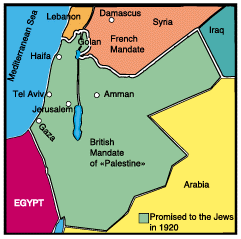
Area of Mandate Palestine

The original area of Palestine, for which the British Mandate was assigned, included Transjordan (what is today Jordan, on the eastern side of the Jordan River).

Credit: Hebroots
In September 1922, very soon after the League of Nations had adopted the Mandate resolution, Britain assigned TransJordan to Hashemite Arabs from Saudi Arabia.  The Jewish part of the Mandate was thus reduced by over 70%.
Jews then had the right to settle anywhere in a 10,000 sq.mi. area between the Jordan River and the Mediterranean Sea.

Mandate Transfer to UN:

With the formal demise of the League of Nations in 1946, the United Nations was established to succeed it.  The UN assumed obligations of the League: Territories under Mandate were to have a “trusteeship system” applied — this was a continuation of the Mandate system of the League.
Article 80 of the UN declared that “nothing in the [UN] Charter shall be construed…to alter in any manner the rights whatsoever of any states or peoples or the terms of existing international instruments.”  This preserved the Jewish right to settle in Palestine.

Violence in Palestine:

From the time of the establishment of the Mandate for Palestine, Arab challenges to it were considerable,  and were often expressed violently.  This was in spite of the fact at that the same that the Mandate for Palestine was established for the Jewish homeland, Mandates for Syria, Lebanon and Iraq were established, all for Arab populations.  Arabs were, and still are, offended by the presence of a Jewish state.
Perhaps most grievous of all was the Hebron massacre of 1929: for three days Arabs went on a murderous rampage in the city, killing 67 Jews and destroying property. In the aftermath, the second holiest city of the Jews was left bereft of Jews for the first time in hundreds of years.  (Ultimately the British prevented Jews from living in the city because they said they couldn’t protect them.)

Partition of Palestine:

In 1947, the British, who no longer wished to contend with the situation, declared intention to pull out by mid-1948, and turned the Mandate back to the United Nations. A UN Commission considered the matter and recommended a partition of Palestine into one state for the Jews and one for the Arabs, with Jerusalem to be internationalized at first.

Credit: Wikipedia
This recommendation was placed before the General Assembly as Resolution 181, which was adopted on November 29, 1947 by a vote of 33 to 12, with 10 abstentions. The Arab nations voted as a bloc against.
It is imperative to note that General Assembly Resolutions carry no weight in international law.  This resolution was only a recommendation — it was not binding and it did not supersede the Mandate for Palestine in international law.
Legally, this plan would have had binding force only as an agreement between the two parties, i.e., the Jews of Palestine and the Arabs of Palestine.
However, while the Jewish population of Palestinian accepted the proposal, the Arab population did not: they rejected the entire resolution.  Thus the partition plan was aborted.
There is no way for Arabs today to re-instate this resolution or to claim that Jews have a right to only what was defined as a Jewish state by this aborted resolution.

Declaration of the Establishment of the State of Israel:

On May 14, 1948 (Hebrew date: 5th of Iyar 5708), the Jewish People’s Council gathered at the Tel Aviv Museum, and approved a proclamation, declaring the establishment of the State of Israel.
It asserted the natural right of the Jewish people to be like all other peoples, exercising self-determination in its sovereign state and proclaimed the establishment of a Jewish state named “the State of Israel.”
It is important to note that Israel’s legal legitimacy did not derive from the aborted partition plan — even though the state was founded on that portion of Palestine that Resolution 181 had allocated for a Jewish state.
It was established according to international norms: based on a declaration of independence by its people and on the establishment of an orderly government within territory under its stable control.
The portion of Palestine on which Israel was not established became unclaimed Mandate land.  Nothing in international law had superseded the status of this land as Mandate land.

War of Independence

Within a day of the establishment of the State of Israel, it was attacked by the states of the Arab League, with clear, openly stated, intention of destroying the new state.
When the war ended in 1949, Israel controlled more territory than it had when independence was declared.  Egypt controlled Gaza, and Jordan controlled Judea and Samaria (the West Bank).  Western Jerusalem was in Israel’s hands, and eastern Jerusalem in Jordan’s hands.

Credit: buildersofzion
Armistice agreements were signed between Israel and the Arab states with which it had been at war.  Armistice lines — temporary ceasefire lines — were defined by these agreements.  They are often referred to as the Green Line.
These armistice demarcation lines did not define a permanent border for Israel. The agreement between Israel and Jordan includes this phrase:
“The Armistice Demarcation Lines defined…in this Agreement are agreed upon by the Parties without prejudice to future territorial settlements or boundary lines…”
This is exceedingly important because the PLO/PA claims that this line is Israel’s “real” border and the line to which it must withdraw.  This is simply not the case.

Six Day War

From June 5 to June 10, 1967, Israel fought a defensive war against Arab forces from Egypt, Syria and Jordan.
When it was over, Israel had control of all of Jerusalem, which was united under Israeli sovereignty; the Golan Heights, to which Israeli civil law was applied; the Sinai, which was surrendered as part of the 1979 peace treaty with Egypt; Gaza, which was surrendered in the 2005 disengagement; and Judea and Samaria.

242

In November 1967, the Security Council adopted Resolution 242, which addressed the situation.
This resolution did not require Israel to withdraw to the Green Line.  Instead it acknowledged the right of every state in the area “to live in peace within secure and recognized boundaries free from threats or acts of force.”
Implicit here was the understanding that the Green Line did not represent a secure boundary.  Israel suffered from a lack of strategic depth within the Green Line — at its narrowest only nine miles wide — which invited attack and made defense in war time difficult. (This is why Israeli statesman Abba Eban referred to the Green Line as the “Auschwitz borders.”)
Thus this resolution called for Israel to withdraw from “territories occupied in the recent conflict.”  “Territories,” not “the territories” or “all territories,” meaning, withdrawal from some but not all of the area of Judea and Samaria.  There is a legal history of long debate over this wording, because of its significance.  Not full withdrawal because that would not leave Israel with a secure boundary.
Once again, then, we see that the claim of the PLO/PA that Israel “must” withdraw to the Green Line is not supported by the facts.
Lastly, the resolution called for “a peaceful and accepted settlement in accordance with the provisions and principles in this resolution.”  That is, it called for negotiations to determine the final border of Israel.
There was no requirement that Israel withdraw prior to negotiations. And those negotiations have never been held.  At the time of this resolution, it was assumed that negotiations would be with Jordan.  Today the situation has changed.

“Occupation”

There is nothing in Resolution 242 that forbids construction of settlements in Judea and Samaria by Israel.  As this issue is a critical one now, we need to look at this a bit closer:
Israel is not an “occupier” in Judea and Samaria.
The word “occupation” is bandied about regularly.  The PA/PLO have adopted the idea of Israel as “occupier” as a mantra and much of the world has accepted it.  But the facts tell us something else.
  • Judea and Samaria were (and still are) unclaimed Mandate land, to which Israel has the strongest claim.
  • Legally, occupation only occurs when one nation moves into the land of another. But there was no nation legally sovereign in Judea and Samaria before 1967 — Jordan’s presence there was not legal
  • There are strong legal precedents for the claim that a war fought defensively permits retention of the land secured in that war.Wrote Steven Schwiebel, former judge of the International Court of Justice:
  • “…the Israeli conquest of Arab and Arab-held territory was defensive rather than aggressive conquest.
    “…it follows that modifications of the 1949 armistice lines.. are lawful…whether those modifications are, in Secretary Rogers’s words, ‘insubstantial alterations required for mutual security’ or more substantial alterations – such as recognition of Israeli sovereignty over the whole of Jerusalem.”

    • With all of the above, it should not be forgotten that areas over the Green Line, in eastern Jerusalem and Judea and Samaria, represent the very heart of Jewish heritage:  From the Temple Mount; to Hevron and the Cave of Machpelah, where the matriarch and patriarchs are buried; to Shilo, where the Tabernacle was brought.  How can Jews be “occupiers” in their own ancient land?

International Law

People have the impression that “international law” is a firmly defined body of law.  In point of fact, while some international law is established in formal documents, others aspects are very fluid.  Just as is the case with “occupation,” there is a tendency to politicize this term, so that Israel is forever accused of “violating international law.”  Be most cautious when hearing this.
There are, as well, instances in which “international law” is interpreted to mean one thing for Israel and another for other countries.
One fascinating example has to do with the Fourth Geneva Convention, Article 49(6), which says “the Occupying Power shall not deport or transfer parts of its own civilian population into the territory it occupies.”  You may have heard accusations that Israel is in defiance of this Article because of the “settlers.”
There are two obvious retorts to this: First, that Israel is not an occupier, and second, that Israel is not deporting or transferring parts of its own civilian population — the people go of their own volition.
Eugene Kontorovich, however, is currently doing research for a paper and has discovered something else:  There are many instances of movement of civilian population into occupied territory.  However, while international lawyers claim that Israel must actively oppose civilian migration, refuse to provide services to settlers, etc., in these other instances the reaction is much more tempered.  That is, the presumed requirements of “international law” are applied selectively to Israel.