Israeli researchers uncover a survival mechanism in cancer cells

An international study led by scientists from the Crick Institute in London and the Hebrew University of Jerusalem revealed a survival mechanism in cancer cells that allows the disease to erupt again even after aggressive treatment. In a paper published in Science, the researchers describe the mechanism by which cancer tumor cells become cancer stem cells that can sustain long-term growth.
When cancer develops, the generated cells are not uniform in their biological properties and contribute differently to tumor development. Only a small portion of cancer cells can form new tumors or metastases, and these are called "cancer stem cells." This disparity between tumor cells poses major challenges in understanding the nature of the tumor, its sensitivity to drugs, and planning an effective treatment that will eliminate all tumor cells.
"Many chemotherapy drugs leave a small amount of cancer stem cells that cause a renewed outbreak of the disease after a few years. It is therefore important to identify cancer stem cells in tumors and characterize the differences between the different tumor cells as the basis for detecting weak spots in the course of the development of the disease," explained Prof. Eran Meshorer, head of the Laboratory for stem cells and epigenetics in the Institute of Life Sciences and a member of the Edmond and Lily Safra Center for Brain Sciences (ELSC) of The Hebrew University of Jerusalem.
Cancer stem cells are not limited to the tumor itself and they are able to engage again in healthy environment and stimulate the disease. To study the characteristics of those unique cells, Prof. Meshorer and doctoral student Alva Biran from the Hebrew University teamed up with Dr. Paula Scaffidi and Christina Morales Torres from The Crick Institute in London. The international research team also included Dr. Ayelet Hashahar Cohen of the Hebrew University, Dr. Rotem Ben-Hamo and Professor Sol Efroni from Bar-Ilan University, and Dr. Tom Misteli from the National Cancer Institute, NIH.
The research team found that in a number of cancer types, those cancer stem cells lose one of their DNA packaging proteins – H1.0. By binding to DNA, H1.0 silences the expression of the genes it binds to.
"We found that the disappearance of H1.0 is crucial for the cancer cells to remain immortal. To understand the mechanism of action, we mapped its interaction with DNA and found that it binds to the genes’ regulatory regions. When H1.0 levels go down, the genes to which it binds can be activated. These genes, it turns out, are the ones which provide the cancer cell with its immortal potential," explained Prof. Meshorer.
The study is based on epigenetics – a scientific field that investigates gene expression in DNA by switching genes on and off. In order to identify the cancer stem cells from other cells in the tumor, the research team studied epigenetic mechanisms that distinguish between the least-sorted cells, with endless division properties and a potential to create growth, and the more sorted cells which lack this ability.
The results showed an inverse relation between H1.0 and the division of cancer cells: "As the H1.0 levels fall, the greater the potential of uncontrolled division of cells. In contrast, high levels of the protein prevent this process. We found that the disappearance of protein H1.0 is characteristic of cancer stem cells and it is necessary to maintain the ability of partition and the potential for growth creation."

The discovery could open the door for medical intervention in cancer stem cells aimed at the restoration of high levels of H1.0 in all cancer cells. While further research is needed to understand the effectiveness of H1.0 protein in preventing the spread of cancer growth, this research advances significantly the study of the mechanisms of cancer stem cells and the relatively new epigenetic approach to cancer research.


Netanyahu slams media for attacks on him as thousands rally in support


Israel’s Prime Minister Benjamin Netanyahu this week blasted the media and the political left for creating “endless stories and headlines” in an attempt to bring him down.
Netanyahu was speaking at a Likud-sponsored rally where thousands of supporters gathered to show their support for the Prime Minister after reports of various scandals, which are claimed to involve Netanyahu.
The Prime Minister told those gathered that the media  “are engaged in an obsessive witch hunt against me and my family in order to execute a coup.”
He continued, the “‘fake news’ media told us that if we didn’t withdraw from part of the motherland, Israel would be isolated.
“What did that old guy with a new beard [a reference to former prime minister Ehud Barak] say? He said the ‘diplomatic tsunami’ is coming. What Tsunami? What isolation? What nonsense. Israel is flourishing in an unprecedented way.”
Speaking to the Israelis gathered he said, “over the past few days you have showered us with support and with love, to a degree that I can’t remember.”
“One person told me wisely that ‘they aren’t only looking to bring you down. They want to bring us down, all of us, the Likud and the entire nationalist camp,” he continued.
“They know they can’t win at the ballot box, so they are trying to bypass democracy and to bring us down without elections.’
“And it’s no coincidence: They know it is no coincidence that we keep winning elections, because we have led Israel to the best situation the country has ever known,” Netanyahu said.
In recent weeks Netanyahu has been accused of bribery and fraud, which as you can see today, he completely denies.

Why Support Israel


It is possible to support Israel, whilst still maintaining a Christian love towards all people in the region. We can desire peace, pray for Israel’s enemies and show God’s love to people of all religions, whilst standing firmly by Israel as God’s chosen people with a historical significance, present existence and future purpose in God’s divine plan.

Here are seven Bible verses that support why Christians should stand with Israel.


1. Israel was created by God

“And I will establish My covenant between Me and you and your descendants after you in their generations, for an everlasting covenant, to be God to you and your descendants after you. Also I give to you and your descendants after you the land in which you are a stranger, all the land of Canaan, as an everlasting possession; and I will be their God.”
Genesis 17:7-8

2. God promises a blessing to those that bless Israel

“I will bless those who bless you,
And I will curse him who curses you;
And in you all the families of the earth shall be blessed.”
Genesis 12:3

3. Jesus considered Jews ‘His family’

“And the King will answer and say to them, ‘Assuredly, I say to you, inasmuch as you did it to one of the least of these My brethren, you did it to Me.’”
Matthew 25:40

4. Christians are called to be ‘watchmen’

“I have set watchmen on your walls, O Jerusalem;
They shall never hold their peace day or night.
You who make mention of the Lord, do not keep silent,
And give Him no rest till He establishes
And till He makes Jerusalem a praise in the earth.”
Isaiah 62:6-7

5. Christians have a duty to bless Israel

“It pleased them indeed, and they are their debtors. For if the Gentiles have been partakers of their (the Jews) spiritual things, their duty is also to minister to them in material things.” (Interpretation added)
Romans 15:27

6. Christians should pray for Jerusalem

“Pray for the peace of Jerusalem: May they prosper who love you.”
Psalm 122:6

7. God has not forsaken His people

“I say then, has God cast away His people? Certainly not! For I also am an Israelite, of the seed of Abraham, of the tribe of Benjamin. God has not cast away His people whom He foreknew.”
Romans 11:1
Bible quotations are from the New King James Version of the Bible 

Teaching the world how to make the desert bloom- Israel Technology


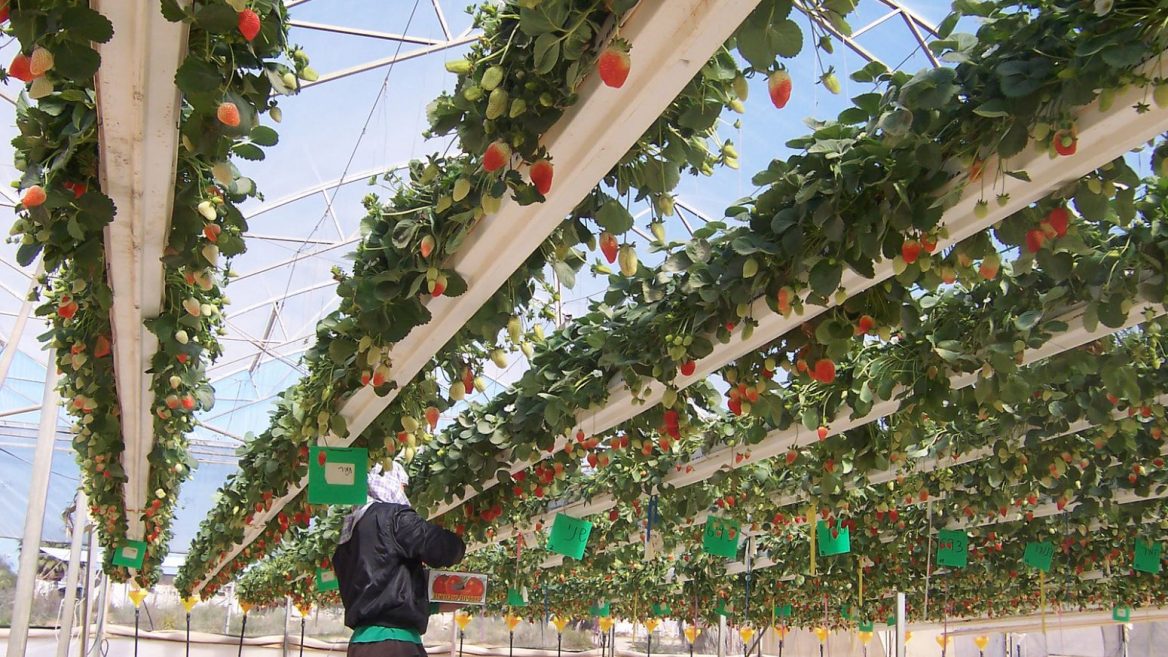
At the Ramat Negev Agro-Research Center, acacia trees bloom, casting long shadows by the greenhouses, and fat pumpkins ripen on the ground. Everywhere you look, jewel-like cherry tomatoes dangle above the sand, on vines strung to wires, carefully irrigated and nourished
While tiny tomatoes have been around for centuries, certain varieties of cherry tomatoes – including the popular tomaccio – were developed in Israel back in the 1970s. Here they grow in abundance, as do sweet peppers of all colors – yellow, green, red, chocolaty-brown, and purple.
The Ramat Negev Regional Council oversees this center, and agricultural experiments are conducted by onsite researchers as well as by scientists from Ben-Gurion University, the agriculture faculty of the Hebrew University, the Volcani Center, and elsewhere, in consultation with the Israeli Extension Service. It is a hotbed of innovation and discovery.
“People come here from all over the world to study how we grow things in the desert and how to fight against the desert’s continuing conquest of their land,” Gadi Grinblat explains.
It was here that scientists determined the importance, when irrigating with brackish water, of directing the water underneath the plant, so that it goes directly to the roots and doesn’t touch the upper parts. Otherwise, the salt in the water will harm the plants’ sensitive green leaves.
Like most Israeli agricultural endeavors, the Agro-Research Center makes use of the drip-irrigation system, which was developed by the country’s Netafim company – the headquarters of which are also located in the Negev, at Kibbutz Hatzerim.
Like the Blaustein Institutes for Desert Research, the Ramat Negev Agro-Research Center is happy to spread the word about its findings with the rest of the world.
Israel’s MASHAV (Agency for International Development Cooperation) helps to make that happen through its agricultural/outreach arm, CINADCO (Center for International Agricultural Development Cooperation), and with the scientific research capabilities of the Volcani Center.
Israeli agro-scientists are regularly sent out to demonstrate their findings, in Africa, Asia, Latin America, Central Europe, and the Middle East – and farmers and scientists from abroad are brought into Israel to study and share their knowledge as well.
Not surprisingly, the focus is on Israel’s areas of expertise: growing food in semi-arid and arid zones, combating “desertification,” irrigation and water management, dairy farming, and strategies for the small farmer. The goals are vast and vital: to ensure food security and economic self-sufficiency.

The Faith of the Farmer


Farming, says the Talmud, is an act of faith. The farmer invests a great deal of effort and expense to plow the land and prepare it for sowing. Then he casts grain into the soil, where it will rot and decompose. Why does he do this? Because he believes in the "Vivifier of the World" -- that G‑d will make the land yield many times the quantity of his investment.
This statement, of course, begs the question: Are there no atheist farmers? The utility of plowing and sowing is a matter of experience: countless generations of farmers have sown and profited from their toil. Why does the act of farming demonstrate ones faith in G‑d any more than the other endeavors, great and small, of human life?

When G‑d created the world, He established certain laws which delineate the manner in which the world operates. The world, however, does not operate on its own: every event that transpires in it -- from the birth of a child to a leaf turning in the wind-represents a direct and purposeful act of G‑d. So the laws of nature are not really laws at all, but divine behavior patterns. The consistency of these behavior patterns-only rarely does G‑d depart from them -- when He does we call the event a miracle -- creates the illusion of laws, as if there is some inherent necessity that things should continue to operate the way they have in the past. In truth, there exists no such inherent necessity, only the divine desire to continue acting upon the world in a manner consistent with these established patterns. If tomorrow the sun were to rise in the west and water were to begin to flow uphill, this would be no more or less miraculous than todays natural reality. The fact that G‑d has thus far chosen to make the sun rise in the east and water flow downhill in no way compels that He continue to do so.
This, of course, is a believer's perspective, the perspective of one who perceives a deeper, more basic reality than meets the eye or than can be dissected in the laboratory. To a more superficial eye, the laws of nature are axiomatic and immutable--laws that not only guarantee that a certain sequence of actions will produce wheat or put a human being on the moon, but which are also the last word on what is, will and ought to be in our world.
Our mission in life is to Know Him in all your ways-to recognize the divine essence of reality and to manifest this truth in everything we do. To live a life that is not subservient to the laws of nature but to their divine author. A life in which the natural reality is respected as the divine modus operandi, but is neither venerated nor awed. A life in which nature is not the dictator of life but the facilitator of lifes purpose to serve ones Creator.
By assuming this perspective and setting it as the guiding principle in everything we do, we penetrate the veil of nature and reveal the divine reality it conceals. Our every deed becomes an exercise in the revelation of G‑dliness, a demonstration of the subservience of nature and the all-pervasiveness of the Divine.

Every man has his own path through life, his own particular area of the veil to penetrate.
For the veil is not uniform, but contains patches of greater and lesser opacity. The world of the businessman, for example, is far less predictable than that of the assembly-line worker. The business that succeeds against all odds, or the deal that is born out of a dozen incredible coincidences, can be explained in such prosaic terms as market forces and statistical probability, but every businessman has encountered the hand of divine providence behind the monotony of natural law. By the same token, the brain-surgeons veil is more translucent than that of the dentist, and the physicist bores deeper than the civil engineer.
Therein lies the specialty of the faith of the farmer. The farmers contact is with the densest, most opaque part of the veil. He is slave to the weather, the contours of the land, the chemistry of the soil; he contends with nature in its rawest, most obstinate, most dictatorial incarnation. So when the farmer recognizes and acts upon the truth that it is the Vivifier of the World who answers his toil with sustenance, this represents the ultimate triumph of faith, the ultimate penetration of spiritual vision through the material haze